
It's not your imagination. Your skin in your 20s had a biological advantage you didn't earn and didn't know you were spending. Here's what changed — and what you can actually do about it.
Almost everyone notices it somewhere in their late 20s or early 30s: the skin that used to look clear and bright without much effort is now requiring more. More products. More time. More products that don't quite deliver what the 20s did for free. It's tempting to assume this is just 'getting older.' But there's a specific, molecular reason your skin's natural glow declines — and it's directly connected to the cellular glutathione story.
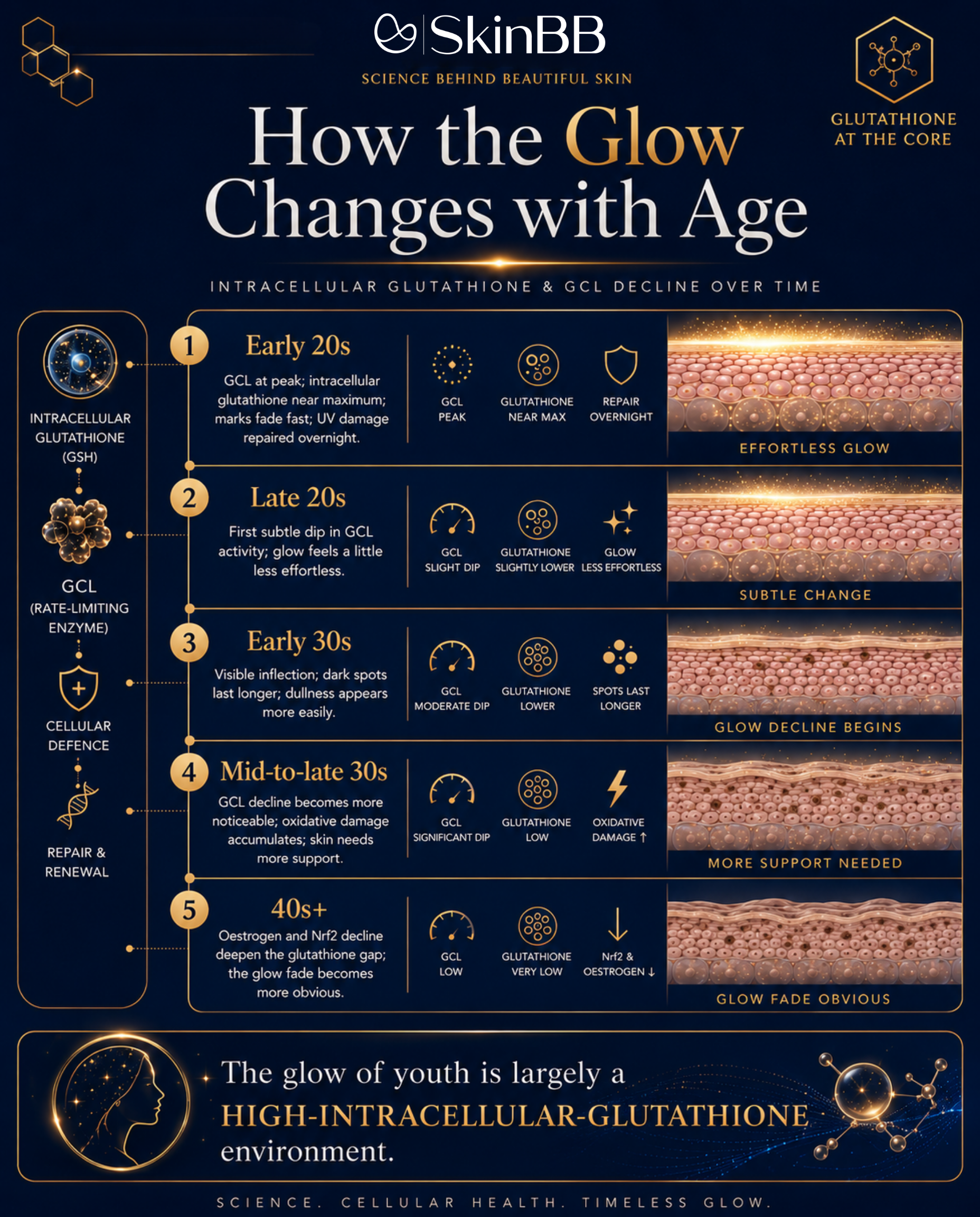
In your 20s, GCL — the enzyme governing step one of glutathione synthesis — is at its genetic peak activity. Your Nrf2 system (the master switch that controls GCL gene expression) responds robustly to oxidative stress, upregulating glutathione production efficiently. Intracellular glutathione levels are near their biological maximum. UV damage from the day gets repaired overnight. Post-inflammatory marks from breakouts fade in days. Tyrosinase is efficiently modulated by the high glutathione environment. The skin's antioxidant bank account is full and replenishing rapidly.
This is what a high intracellular glutathione environment looks like from the outside: effortless skin clarity. The glow people associate with youth isn't primarily genetics — it's cellular chemistry.
GCL expression begins declining, driven by reduced Nrf2 responsiveness. The cell produces less GCL enzyme — meaning the synthesis rate slows. The daily depletion from UV and pollution continues at the same pace; the replenishment rate drops. The gap begins. Dark spots take longer to fade. Morning skin that was once effortlessly radiant now needs more help. Skin texture becomes slightly less smooth — because free radical damage is accumulating at a rate the weakened antioxidant system can't fully address overnight.
This is the inflection that most Indian women notice between 28 and 35 — and most describe it as needing more products, switching routines more frequently, feeling like nothing is 'working' the way it used to. The products haven't changed. The cellular chemistry has.
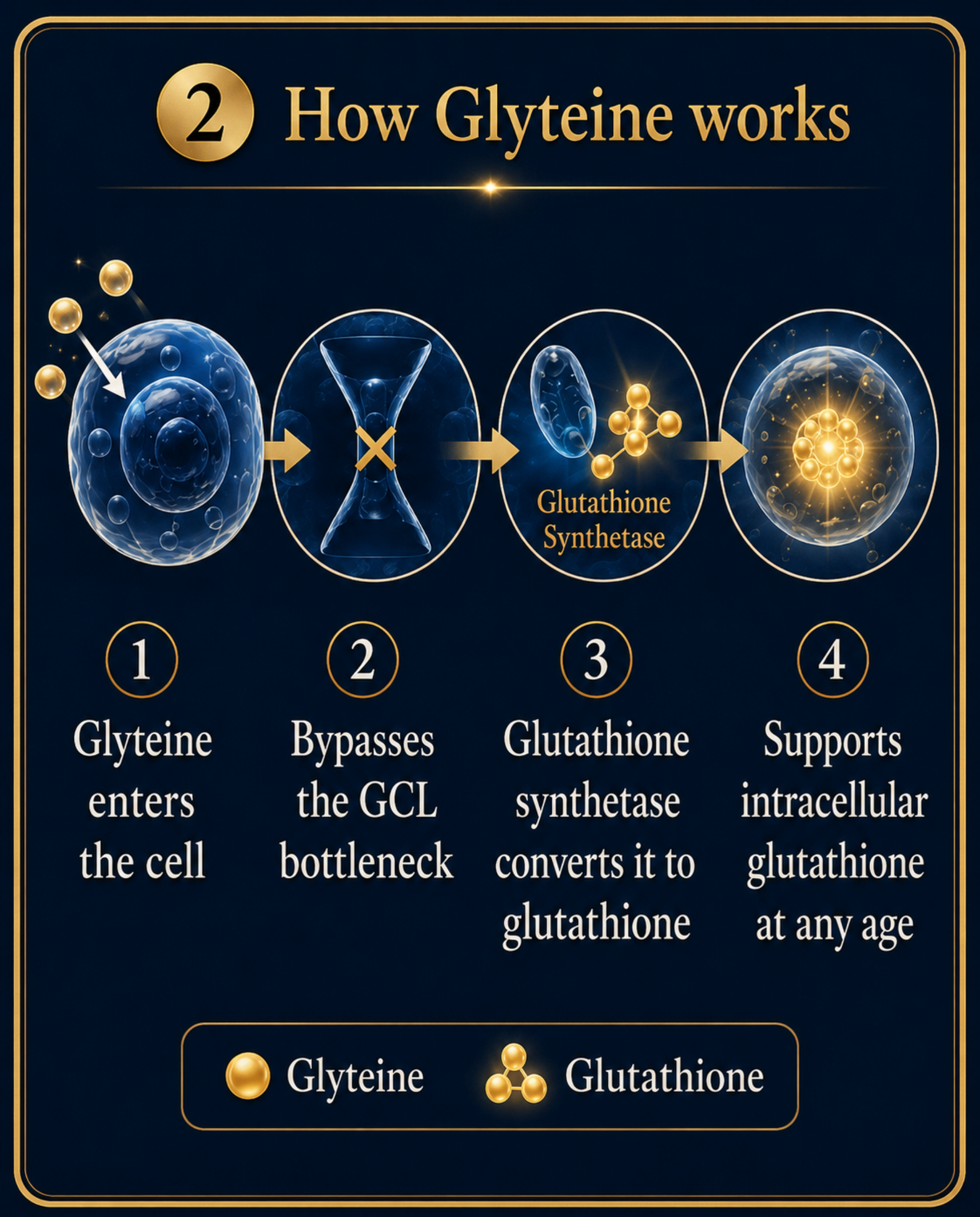
Here's the elegant part: Glyteine® bypasses GCL entirely. It doesn't matter whether your GCL is at peak (age 22) or significantly reduced (age 42) — Glyteine® delivers γ-glutamylcysteine directly to the cell, and glutathione synthetase (step two, less regulated, fast) converts it to glutathione. The GCL bottleneck — whose decline is the core reason your glow fades — is irrelevant when you take Continual-G.
This is why Continual-G works at any age, but the impact is most dramatic in the 30s and 40s — the decade when the GCL decline has progressed enough to create a visible gap between the skin you have and the skin you remember having. For users in their 20s, Continual-G is prevention — maintaining high intracellular glutathione before the decline takes hold. For users in their 30s, it's correction — restoring the cellular environment that produced the 20s glow.
Indian urban women consistently report noticing skin changes earlier than their counterparts in lower-pollution environments — often in their late 20s rather than early-to-mid 30s. This makes biological sense. The extraordinary daily depletion from Indian urban PM2.5 and UV accelerates the gap between 'glutathione made' and 'glutathione needed.' The GCL decline from ageing is compounding an already-stressed system. The result: the invisible cellular deficit becomes visible in the skin earlier in Indian women than in equivalent age groups globally. Continual-G was designed with this reality in mind.
The glow that fades after 30 is not inevitable ageing — it's a specific, measurable decline in GCL activity and intracellular glutathione that results from the combination of Nrf2 decline, cumulative oxidative damage, and (in India) extraordinary environmental depletion. Continual-G with Glyteine® bypasses the GCL bottleneck whose decline is the core cause — making intracellular glutathione available at any age regardless of GCL status. The glow isn't gone. The factory just needs better materials. Continual-G provides them.
1. What age should I start Continual-G?
Ideally in your mid-to-late 20s, when GCL activity is still high but the decline is beginning — for prevention. The 30s are when the visible impact is most dramatic. The 40s are when it becomes maintenance against an accelerating decline. Any age is the right age to start.
2. Does menopause affect glutathione?
Yes significantly. Oestrogen activates Nrf2, which governs GCL expression. As oestrogen declines in perimenopause and menopause, GCL activity falls further, accelerating the glutathione deficit. Continual-G's GCL-bypassing mechanism is particularly relevant for perimenopausal and postmenopausal women.
3. Can Continual-G reverse ageing?
No supplement reverses structural ageing in collagen and elastin from decades of accumulated damage. What Continual-G does is significantly slow the rate of ongoing oxidative damage and support the biological processes (tyrosinase modulation, antioxidant recycling) that govern visible radiance and skin evenness from within.
4. Is this the reason some people glow after pregnancy even though they're 'older'?
During pregnancy, hormonal changes actually boost Nrf2 activity temporarily — increasing glutathione synthesis. Many women notice their skin looking clearer during pregnancy for exactly this cellular reason. The postpartum drop reverses this, contributing to the dull skin many new mothers experience. Continual-G can support the cellular antioxidant system during the postpartum period, but check with your doctor if nursing.
5. Will my skin return to my 20s glow with Continual-G?
The biological ceiling of what's possible depends on the current state of your skin's structure. For most users in their 30s and 40s, the improvement over an 8–12 week protocol is significant and visible — more even tone, clearer skin, improved radiance. How close it gets to 'the 20s' depends on individual factors. But the cellular mechanism is real.
