
HIGHLIGHTS• Two paths exist for a beauty marketplace at the listing stage. The first is to ask the brand to confirm legal compliance and publish what's submitted. The second is to look at the product yourself before listing, against published standards. SkinBB chose the second. PRAC is how that choice is operationalised. • PRAC is a multidisciplinary committee spanning regulatory and labelling, dermatology, pharmacology and toxicology, formulation and manufacturing, and nutraceutical and FSSAI compliance. It reviews both personal care and nutraceutical products against the same structured standards. Each member has a primary responsibility and a vote. No product is listed without the committee's approval. • The boundaries are deliberate. PRAC reviews compliance, claims, ingredients and manufacturer credibility, and a dermatologist looks at the finished formulation. PRAC does not run efficacy trials, does not conduct its own safety studies, does not audit factories, and does not endorse brands. These limits are the design, not gaps in it. |
When SkinBB began assembling its product catalogue, the founders faced a choice that every beauty marketplace eventually faces, even if most do not acknowledge it openly. When a brand applies to list a product, what do you actually verify?
Option one is the path of least resistance. You ask the brand to confirm that the product complies with Indian law. You collect a copy of the manufacturing licence. You publish what the brand sends you. If something goes wrong later, you take the product down. Most large marketplaces operate close to this end of the spectrum. It is fast, scalable, and legally defensible — the brand has made the declaration; the platform has acted in good faith.
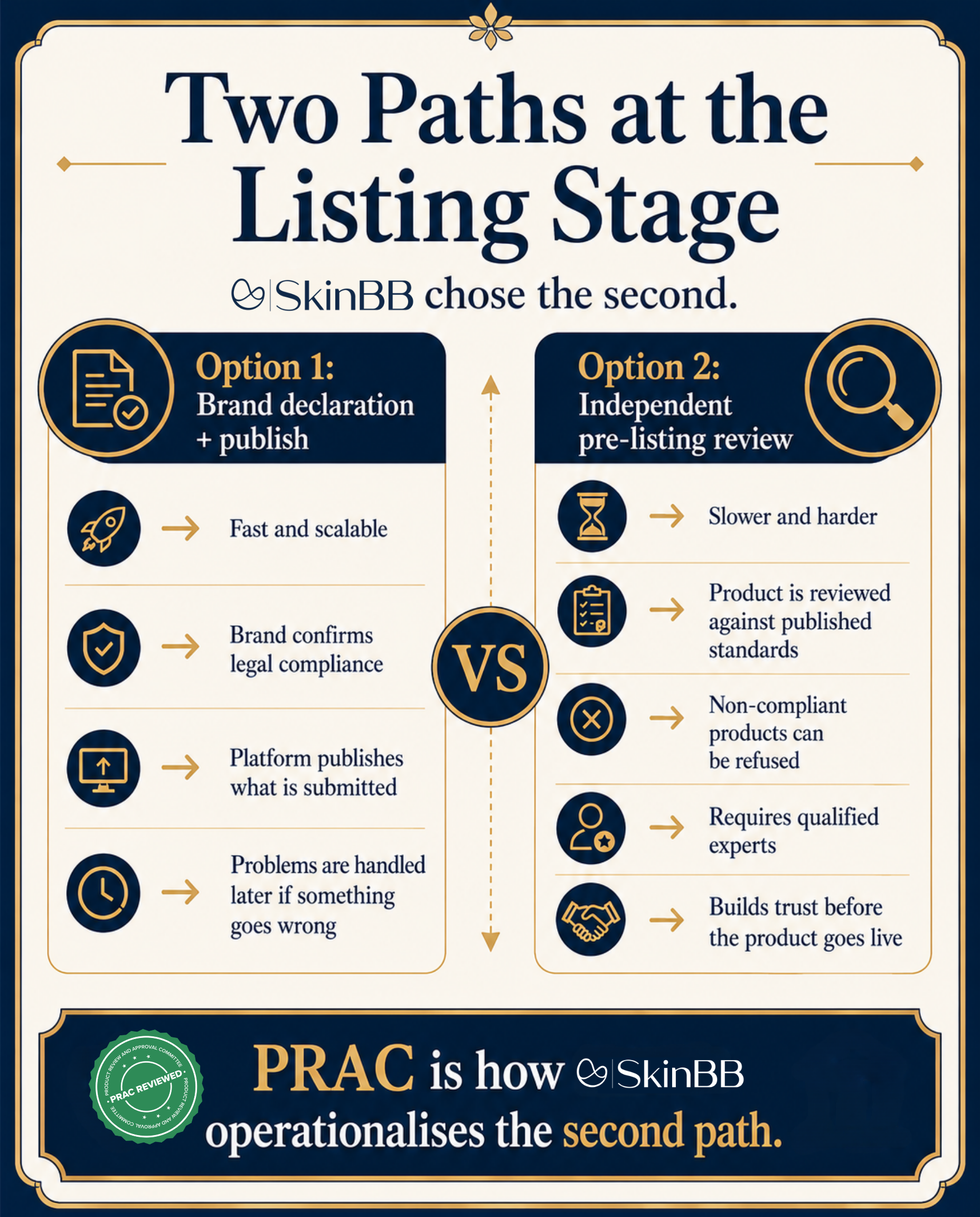
Option two is to look at the product yourself before it goes live, against published standards, and refuse to list it if it does not measure up. This is slower. It is harder. It limits how quickly the catalogue can grow. And it requires people qualified to make the judgments. SkinBB chose this second path. The Product Review and Approval Committee — PRAC — is how we operationalise that choice.
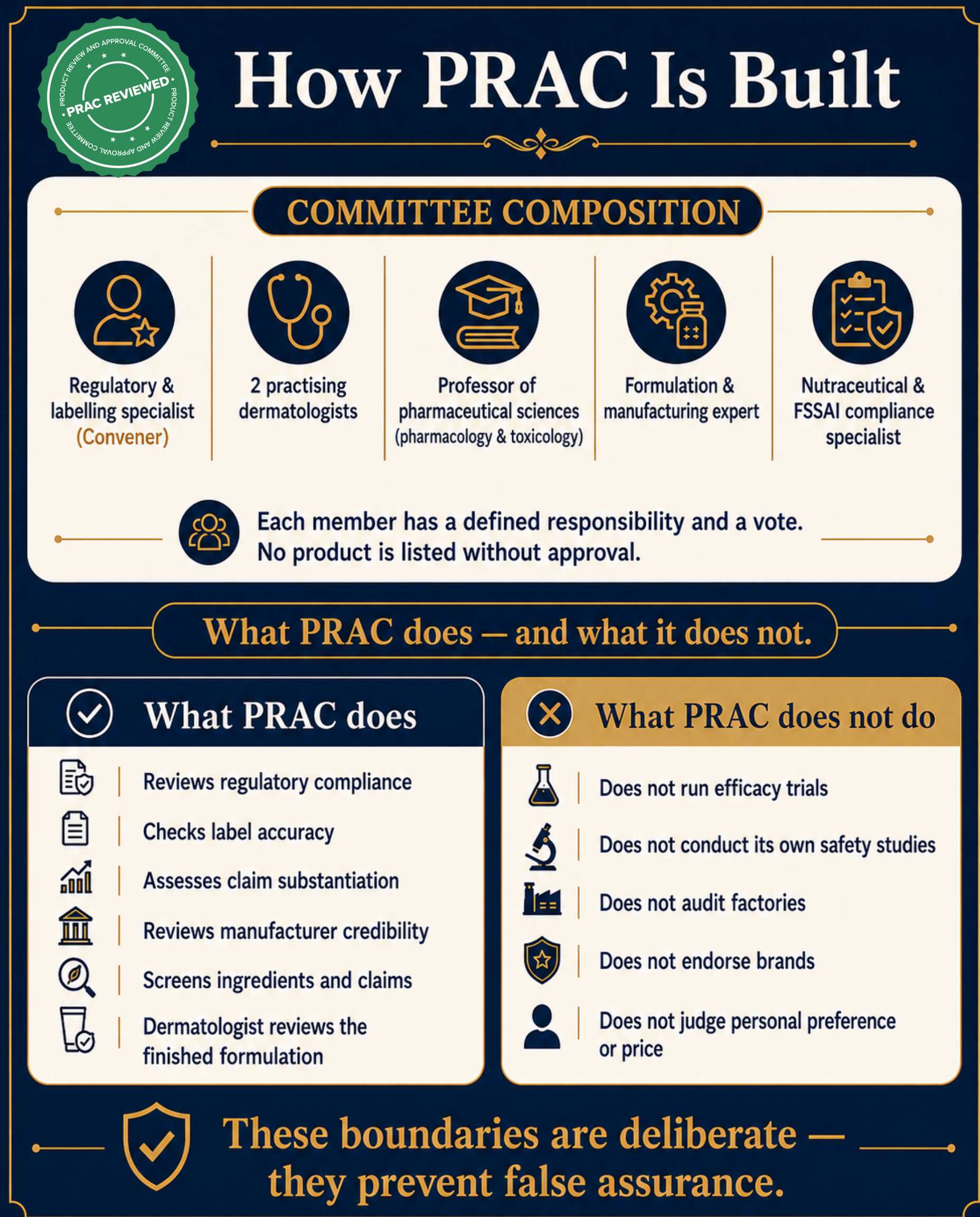
PRAC reviews every product against four substantive standards: regulatory compliance, label accuracy, claim substantiation, and manufacturing credibility. It runs six structured verification screens to do this work, each with published criteria and decision rules. The Convener consolidates the votes and tracks every condition to closure.
In practice, what PRAC does is read carefully. It reads the label against the Legal Metrology Rules, the D&C Rules, FSSAI regulations and the Consumer Protection (E-Commerce) Rules. It reads the INCI list against an ingredient watchlist of fifty-nine substances and six categories of hidden hazards. It reads every claim — on pack, on artwork, on the website — against the D&C Act, FSSAI advertising regulations, the DMRA 1954, the ASCI Code and the consumer protection framework. It reads the manufacturing dossier and applies decades of collective industry knowledge to ask whether the facility is credible. And a practising dermatologist reads the finished formulation as a whole, not as a list of parts.
The boundaries of what the committee does — and what it does not — are deliberate. PRAC does not test products. It does not run efficacy trials. It does not conduct its own safety studies. It does not audit manufacturing facilities. It does not endorse brands. It does not comment on whether a product is worth its price, whether the texture is pleasant, or whether it will work for any individual's skin.
These limits are not gaps in the design — they are the design. A private body that overreaches into spaces already occupied by laboratories, regulators and clinicians would create false assurance, not real protection. PRAC is a documentary and judgmental review. It is no substitute for primary testing, and it is not pretending to be one.
SkinBB built PRAC because being a marketplace involves more than being a checkout counter. When a consumer buys a product from us, they are placing some measure of trust in the platform. PRAC is the structure that decides whether that trust is earned, product by product, before listing. The next two posts in this series explain what passing PRAC actually means, and how the six-screen process produces a single decision.
Critical Citations
1. SkinBB Product Review & Approval Committee — Charter & SOP, SBB-PRAC-001 v1.0.
2. The Drugs and Cosmetics Act, 1940 and Rules, 1945. Government of India.
3. Advertising Standards Council of India (ASCI) — The Code for Self-Regulation in Advertising.
4. Consumer Protection Act, 2019 and Consumer Protection (E-Commerce) Rules, 2020. Government of India.
