
If you follow health or skincare trends in India, you have almost certainly heard of glutathione. It appears on supplement labels, in dermatology clinics, and across social media. But what exactly is this molecule, and why do scientists call it the master antioxidant?
Glutathione (abbreviated GSH) is a small tripeptide composed of three amino acids: glutamate, cysteine, and glycine. It is produced naturally inside virtually every cell of the human body. Unlike most antioxidants that you consume through food, glutathione is synthesised endogenously, meaning your cells manufacture it on demand.
What makes it unique is its location. Glutathione operates inside the cell — in the cytoplasm, the mitochondria, and the nucleus. This intracellular presence is critical because most oxidative damage occurs within cells, not in the bloodstream. A 2023 review in Vitamins and Hormones confirmed that glutathione remains the most abundant non-protein thiol in mammalian cells, present at millimolar concentrations.
While the “master antioxidant” label is accurate, it dramatically undersells what glutathione actually does. Published research identifies at least five distinct biological roles.
First, free radical neutralisation. Glutathione directly scavenges reactive oxygen species (ROS) and reactive nitrogen species, protecting DNA, proteins, and cell membranes from oxidative damage. Second, it serves as a critical cofactor for detoxification. Through Phase II conjugation reactions catalysed by glutathione S-transferases, GSH binds to toxins, heavy metals, drug metabolites, and environmental pollutants, making them water-soluble for excretion.
Third, immune regulation. Lymphocytes — the white blood cells at the centre of your immune response — depend on adequate intracellular glutathione to proliferate and function. Research has shown that glutathione-depleted lymphocytes exhibit impaired immune responses. Fourth, glutathione recycles other antioxidants. It regenerates vitamins C and E from their oxidised forms, effectively multiplying the body’s total antioxidant capacity.
Fifth, and often overlooked: protein protection. Glutathione maintains the sulfhydryl (–SH) groups of proteins in their reduced, functional state. When these groups become oxidised, proteins misfold and lose function. Glutathione prevents this through a process called glutathionylation.
Glutathione concentrations are highest in the liver (the body’s primary detoxification organ), the lungs (first line of defence against inhaled pollutants), the kidneys, and the eyes. The brain also maintains significant glutathione reserves, and declining brain glutathione has been associated with neurodegenerative conditions in multiple studies.
For skin health specifically, glutathione plays a dual role: it protects skin cells from UV-induced oxidative damage and it directly modulates melanin production inside melanocytes. This dual function is why glutathione has attracted enormous interest in dermatology, particularly in India where skin radiance is a significant consumer concern.
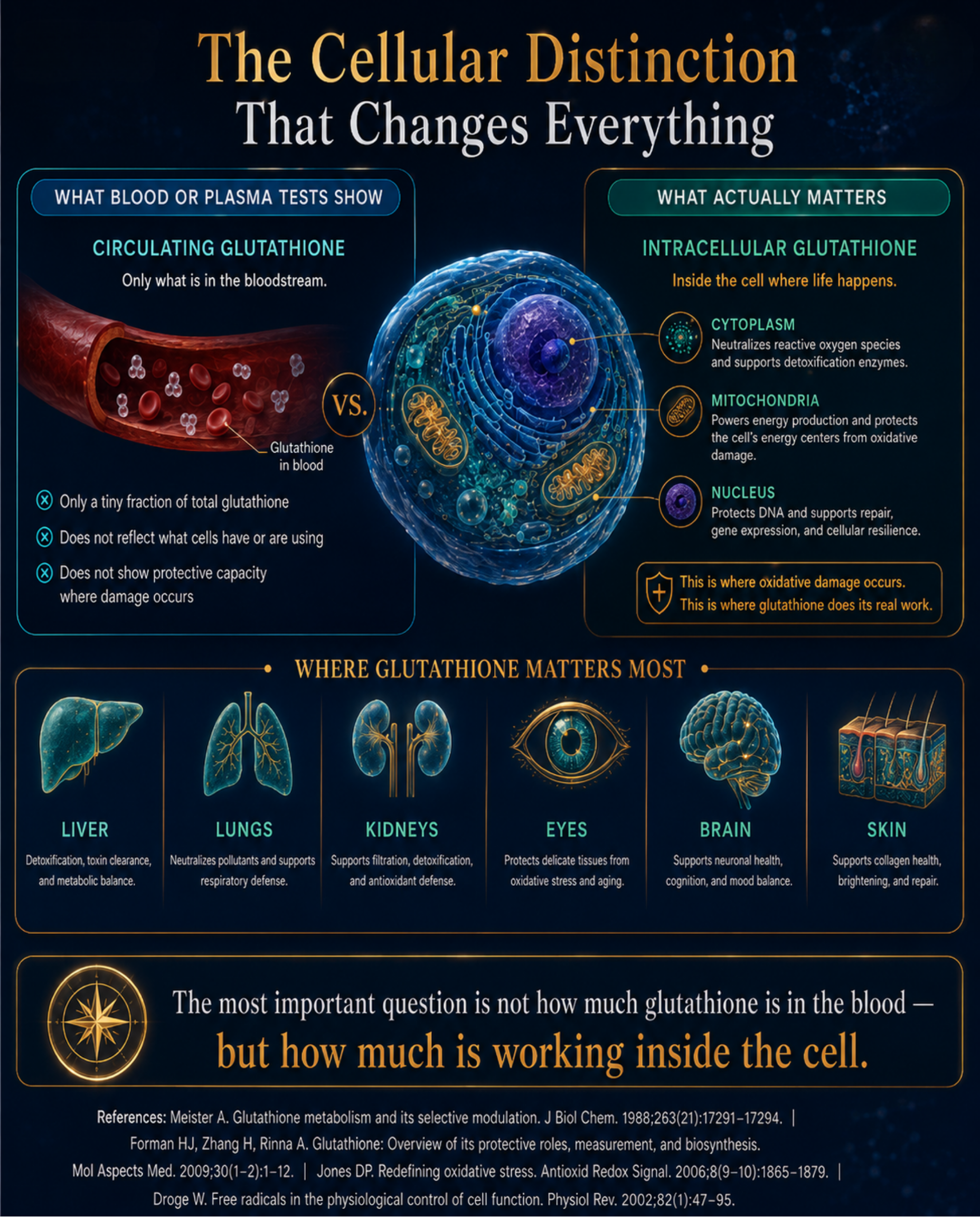
Here is the insight that most supplement marketing overlooks: glutathione’s work happens inside cells, not in the blood. When researchers measure blood or plasma glutathione levels after supplementation, they are measuring what is circulating — not what is operating within cells where the actual protective work occurs.
This distinction between intracellular and plasma glutathione will become a recurring theme throughout this series. It is the single most important concept for evaluating whether any glutathione approach is genuinely effective at the cellular level.
Continual-G can play an important role if it is designed to support the body’s intracellular glutathione system, rather than simply increasing circulating glutathione in the blood. Glutathione does its most meaningful work inside cells — especially in the cytoplasm, mitochondria, and nucleus — where oxidative stress, detoxification, immune signalling, and protein protection actually happen. A strong glutathione-support formula should therefore help the body maintain the full glutathione cycle: supplying key building blocks, supporting natural synthesis, helping recycling from oxidised glutathione back to active glutathione, and protecting cells from continuous oxidative burden. This is where Continual-G can be positioned as more than a standard antioxidant supplement: its value lies in supporting steady, ongoing glutathione availability inside cells, where the body needs it most. By helping sustain this intracellular antioxidant reserve, Continual-G may support better cellular defence, detox capacity, immune resilience, skin protection, and recovery from daily oxidative stress. The key message is that the goal is not just “more glutathione in the bloodstream,” but more usable glutathione inside the cell — and that is the cellular distinction that makes Continual-G relevant.
1. Forman HJ, Zhang H, Rinna A. Glutathione: overview of its protective roles, measurement, and biosynthesis. Mol Aspects Med. 2009;30(1–2):1–12. Available from: https://doi.org/10.1016/j.mam.2008.08.006
2. Averill-Bates DA. The antioxidant glutathione. Vitam Horm. 2023;121:109–141. Available from: https://doi.org/10.1016/bs.vh.2022.09.002
3. Lushchak VI. Glutathione homeostasis and functions: potential targets for medical interventions. J Amino Acids. 2012;2012:736837. Available from: https://doi.org/10.1155/2012/736837
4. Ghezzi P. Role of glutathione in immunity and inflammation in the lung. Int J Gen Med. 2011;4:105–113. Available from: https://doi.org/10.2147/IJGM.S15618
5. Sonthalia S, Daulatabad D, Sarkar R. Glutathione as a skin whitening agent: facts, myths, evidence and controversies. Indian J Dermatol Venereol Leprol. 2016;82(3):262–272. Available from: https://doi.org/10.4103/0378-6323.179088
