
If your anti-dandruff shampoo worked beautifully for six months and then quietly stopped, you're not imagining it, and you're not using it wrong. The scalp is a living microbial ecosystem, and the same shampoo that knocked it back into balance once may stop working for reasons now well-documented in dermatological microbiology.
Dandruff is a condition of fungal overgrowth, not insufficient moisturisation. The dominant organism is a yeast called Malassezia — most commonly Malassezia restricta on the scalp — which lives on essentially every adult scalp as part of the normal microbiome. It coexists peacefully with bacteria like Cutibacterium and Staphylococcus species in healthy scalps. The trouble starts when it overgrows.
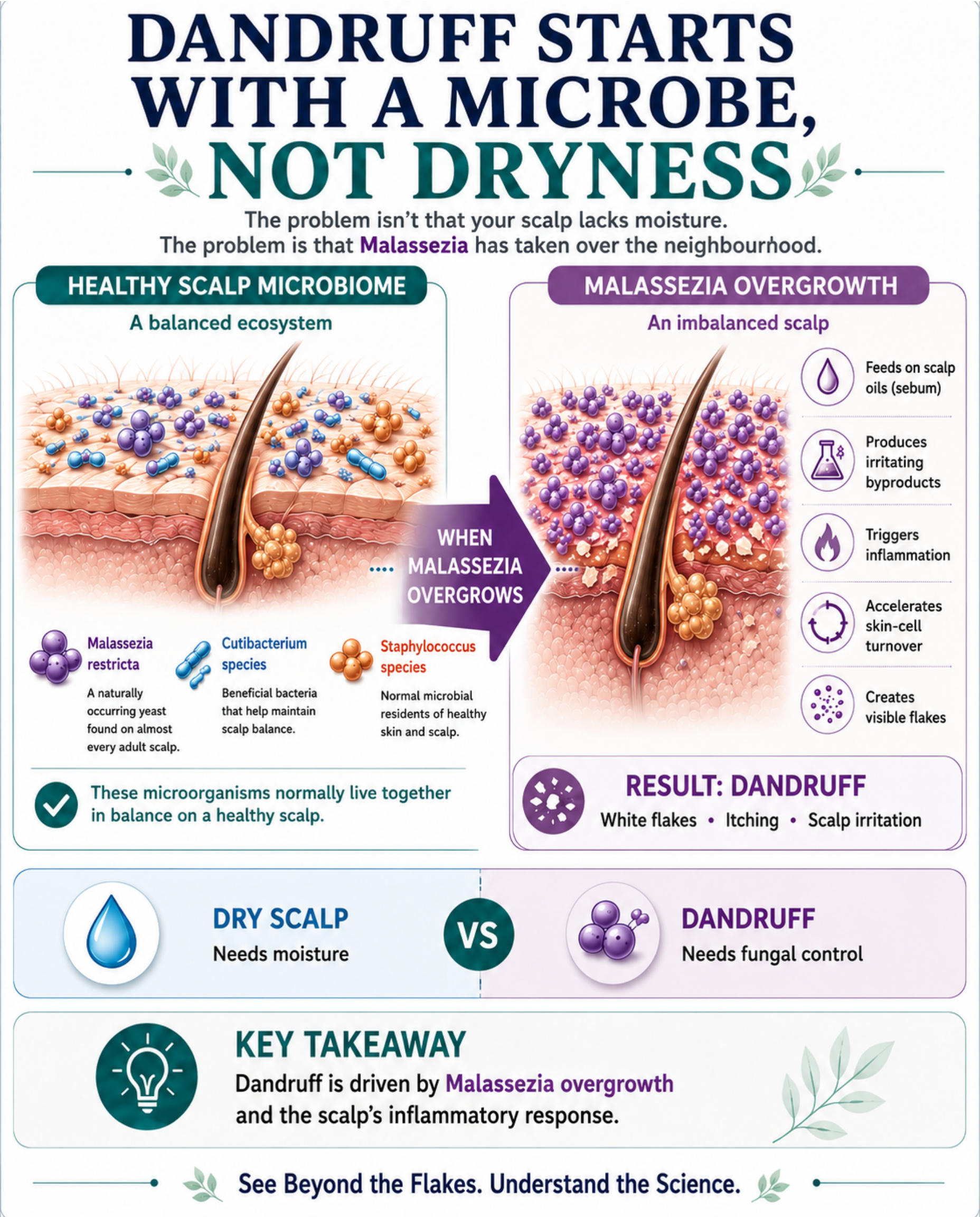
The yeast feeds on sebum lipids and produces irritating byproducts (oleic acid is the most-studied), which trigger inflammation, accelerated skin-cell turnover, and the visible flakes you recognise. So dandruff is biologically closer to an athlete's-foot situation than a dryness one — which is why moisturising shampoos don't fix it, and antifungals do.
Resistance. Malassezia can develop genuine pharmacological resistance to azole antifungals, characterised at the genomic level. A 2020 paper in Frontiers in Cellular and Infection Microbiology isolated ketoconazole-resistant M. restricta strains directly from patients with dandruff and identified the genetic mechanism. In plain terms: some Malassezia strains have multiplied the genes the drug targets, producing more of the affected proteins and diluting the drug's effect. Use any one azole antifungal continuously for months and you select for the resistant strains in your own scalp's yeast population.
Microbiome dysbiosis. Even when the drug still works against Malassezia specifically, killing one organism repeatedly disturbs the rest of the ecosystem. The scalp microbiome can collapse into a less diverse, less resilient state. The flakes go away, but the scalp becomes more reactive — itching, sensitivity, and rebound flaking when you stop.
Both mechanisms point to the same principle: using one antifungal continuously for months is not the optimal strategy.
Rotate active ingredients, not brands. A user buying "different" drugstore anti-dandruff shampoos but ending up with zinc pyrithione in every bottle is rotating brands, not actives. True rotation: zinc pyrithione for a few weeks, then ketoconazole, then selenium sulphide or piroctone olamine, then circle back. Different mechanisms hit different fungal targets, and rotation reduces resistance pressure.
Don't use medicated shampoos every wash. Once dandruff is under control, two to three uses per week — alternating with a gentle non-medicated shampoo — maintains balance without depleting the rest of the microbiome.
Match strength to severity. Mild flaking responds to zinc pyrithione or piroctone olamine. Moderate-to-severe dandruff often needs ketoconazole or selenium sulphide. Using the strongest formula when you don't need it accelerates resistance without added benefit.
Give it contact time. All antifungals work better when left on the scalp for three to five minutes before rinsing. Piroctone olamine in particular has good scalp residence — it continues acting after rinsing — but only if it actually contacted the scalp long enough to bind.
See a dermatologist if rotation doesn't help. Persistent dandruff that doesn't respond to multiple actives may not be straightforward dandruff. Could be seborrhoeic dermatitis, scalp psoriasis, a fungal pattern that needs prescription oral antifungals, or something else entirely. This is where dermatologist territory begins.
Dandruff is a microbial condition, anti-dandruff shampoos are antifungals, and antifungals lose effectiveness over time through resistance and microbiome disruption. The fix isn't a stronger formula — it's rotating across the five evidence-backed actives, using restraint in frequency, and matching the active to the severity. The scalp ecosystem is more like soil than a surface to be cleaned. Treat it that way and most dandruff stays manageable long-term.
1. Park, M., et al. (2020). Genomic Multiplication and Drug Efflux Influence Ketoconazole Resistance in Malassezia restricta. Frontiers in Cellular and Infection Microbiology, 10:191. https://pmc.ncbi.nlm.nih.gov/articles/PMC7203472/
2. Schmidt-Rose, T., et al. (2011). Efficacy of a piroctone olamine/climbazol shampoo in comparison with a zinc pyrithione shampoo in subjects with moderate to severe dandruff. International Journal of Cosmetic Science, 33: 276–282. https://onlinelibrary.wiley.com/doi/abs/10.1111/j.1468-2494.2010.00623.x
3. Piérard-Franchimont, C., et al. (2002). A Multicenter Randomized Trial of Ketoconazole 2% and Zinc Pyrithione 1% Shampoos in Severe Dandruff and Seborrheic Dermatitis. https://pubmed.ncbi.nlm.nih.gov/12476017/
4. Saxena, R., et al. (2018). The diversity and abundance of fungi and bacteria on the healthy and dandruff affected human scalp. PLOS ONE. https://pmc.ncbi.nlm.nih.gov/articles/PMC6919596/
