The Indian beauty and wellness market is one of the largest in the world. Tens of thousands of cosmetic, personal care and nutraceutical products are sold across pharmacies, supermarkets, salons, social-commerce stores and dozens of e-commerce platforms. New brands launch every week. Most of them go straight to the consumer.
Behind this growth sits a regulatory framework that is, on paper, comprehensive. The Drugs and Cosmetics Act, 1940 defines what a cosmetic can and cannot claim. The Food Safety and Standards Act, 2006 and the FSSAI Advertising and Claims Regulations, 2018 do the same for nutraceuticals and health supplements. The Drugs and Magic Remedies (Objectionable Advertisements) Act, 1954 prohibits advertising of remedies for a long list of conditions, across both categories. Legal Metrology (Packaged Commodities) Rules, 2011 set out exactly what every pack must declare. The Consumer Protection Act, 2019 and the E-Commerce Rules, 2020 prohibit misleading information on online platforms. The Advertising Standards Council of India publishes a self-regulatory code that the industry is expected to follow. In principle, this framework is enough.
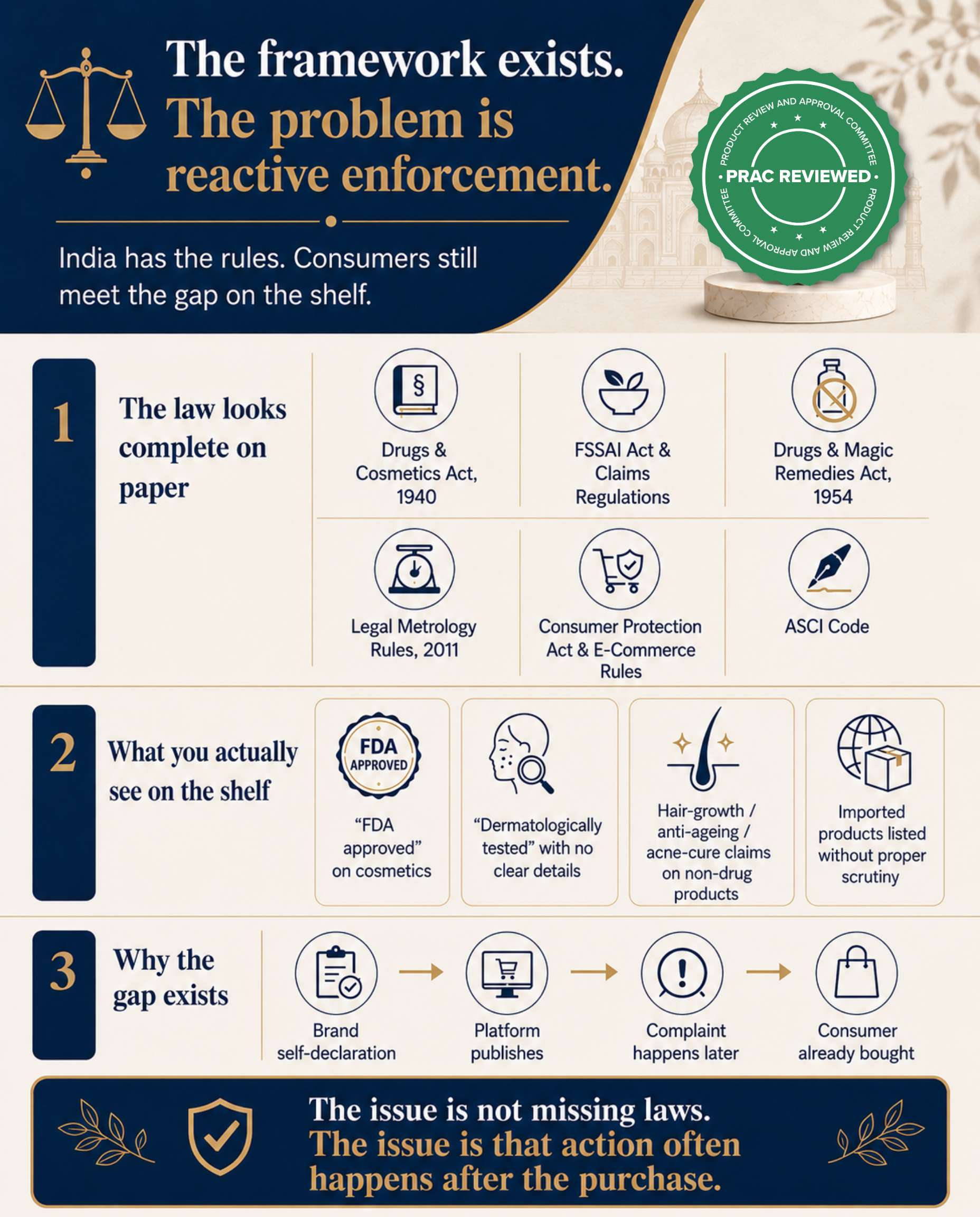
In practice, the framework is reactive. A misleading claim is acted on when somebody complains. A non-compliant label is corrected when an inspector happens to notice. An imported product appears on a marketplace without anyone checking whether its registration is current. The system relies on enforcement to discover problems after consumers have already bought the product.
Walk through any pharmacy or scroll through any large beauty marketplace and the gap becomes visible. You will see "FDA Approved" on cosmetic packs that have nothing to do with the US FDA. You will see "Dermatologically Tested" without any indication of who tested what, on whom, or to what end. You will see hair-growth, anti-ageing and acne-cure claims on products not licensed as drugs. None of this is hidden. It is hiding in plain sight, in clear violation of laws that already exist.
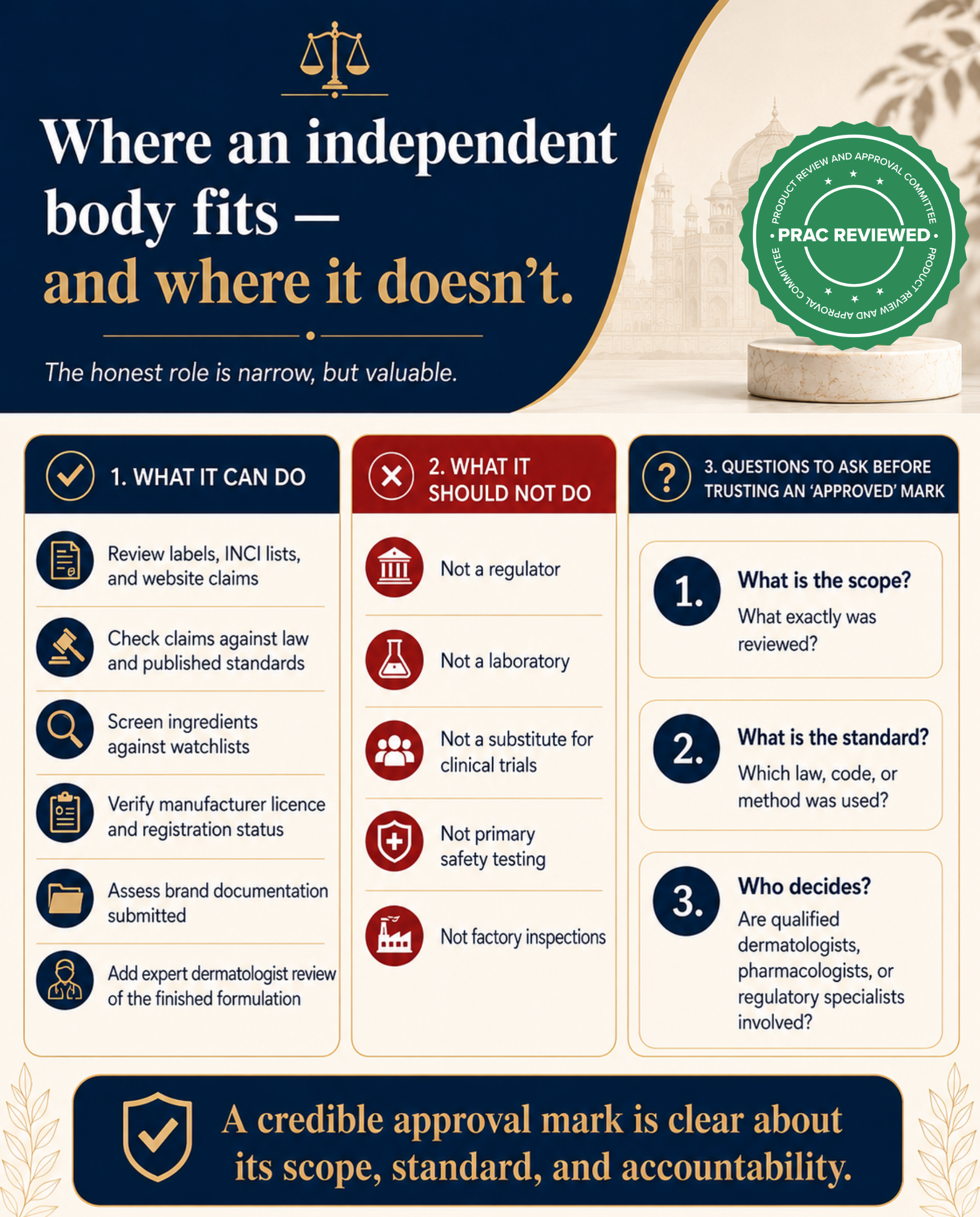
A private body that overreaches into spaces already occupied by laboratories, regulators and clinicians would create false assurance, not real protection. Independence does not mean omniscience. The most honest approval body is one that publishes its scope and stays inside it: documentation review, claim review, ingredient screening, manufacturer credibility, clinical safety judgment on the finished formulation. Efficacy, primary safety testing, factory inspections — those belong elsewhere.
The Indian beauty industry does not need another sticker, another seal or another celebrity endorsement. It needs a layer of pre-listing scrutiny that is independent of the brand, independent of the marketplace's commercial team, and answerable to a published standard. Done with the right limits, an independent approval body is the closest thing the consumer has to a structured second opinion before a product reaches the cart. This is the gap SkinBB set out to close.
Critical Citations
1. The Drugs and Cosmetics Act, 1940 and Drugs and Cosmetics Rules, 1945. Government of India. https://cdsco.gov.in
2. The Food Safety and Standards Act, 2006 and FSSAI (Advertising and Claims) Regulations, 2018. https://fssai.gov.in
3. The Drugs and Magic Remedies (Objectionable Advertisements) Act, 1954. Government of India.
4. Legal Metrology (Packaged Commodities) Rules, 2011. Ministry of Consumer Affairs, Food and Public Distribution.
5. Consumer Protection Act, 2019 and Consumer Protection (E-Commerce) Rules, 2020. Government of India.
6. Advertising Standards Council of India (ASCI) — The Code for Self-Regulation in Advertising. https://www.ascionline.in
