
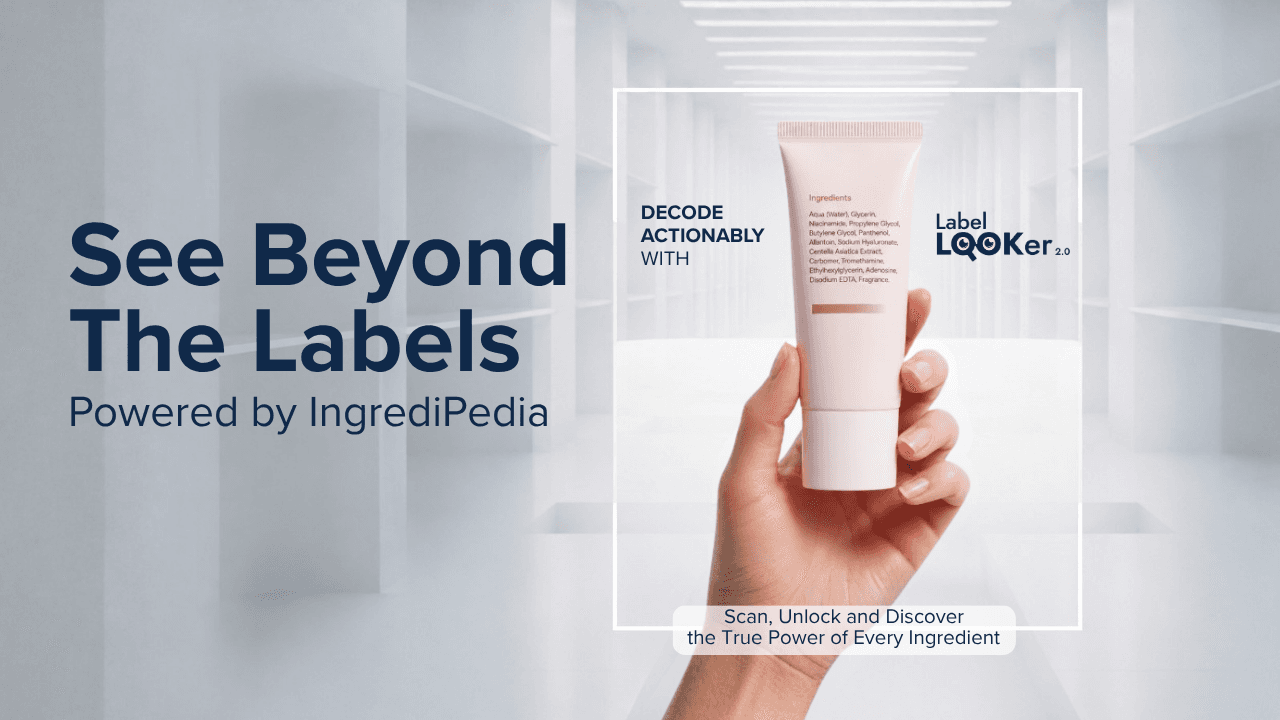
Every product tells you a story on the front of the pack. The truth is on the back — in a language most of us were never taught to read. Label Looker exists to close that gap.
The beauty aisle runs on a quiet asymmetry. The front of every pack is written to be read: bold, benefit-led, engineered to persuade. The back is written to comply — a dense column of names that most buyers skip, not out of indifference, but because they were never given the tools to parse it. The claim is loud. The evidence is small print.
SkinBB built Label Looker to invert that order. It is an AI ingredient decoder, built on IngrediPedia, that lets you move past the claim to the formulation, and past the formulation to what it actually does on skin. It does not ask you to trust a label. It teaches you to read one.
A product can promise almost anything. "Natural," "clean," "gentle," "dermatologically tested" — these are marketing positions, not regulated facts, and they routinely sit on packs whose ingredient lists tell a more complicated story. Reading that list is not a matter of curiosity. It is the difference between a formulation that suits your skin and one that quietly works against it.
The risks are well documented. Preservatives such as parabens and formaldehyde-releasing agents extend shelf life but carry safety questions that deserve scrutiny. Fragrance — even where it is described as natural — remains one of the most common triggers of skin irritation. Sensitisers and allergens hide in plain sight, listed correctly and understood by almost no one.
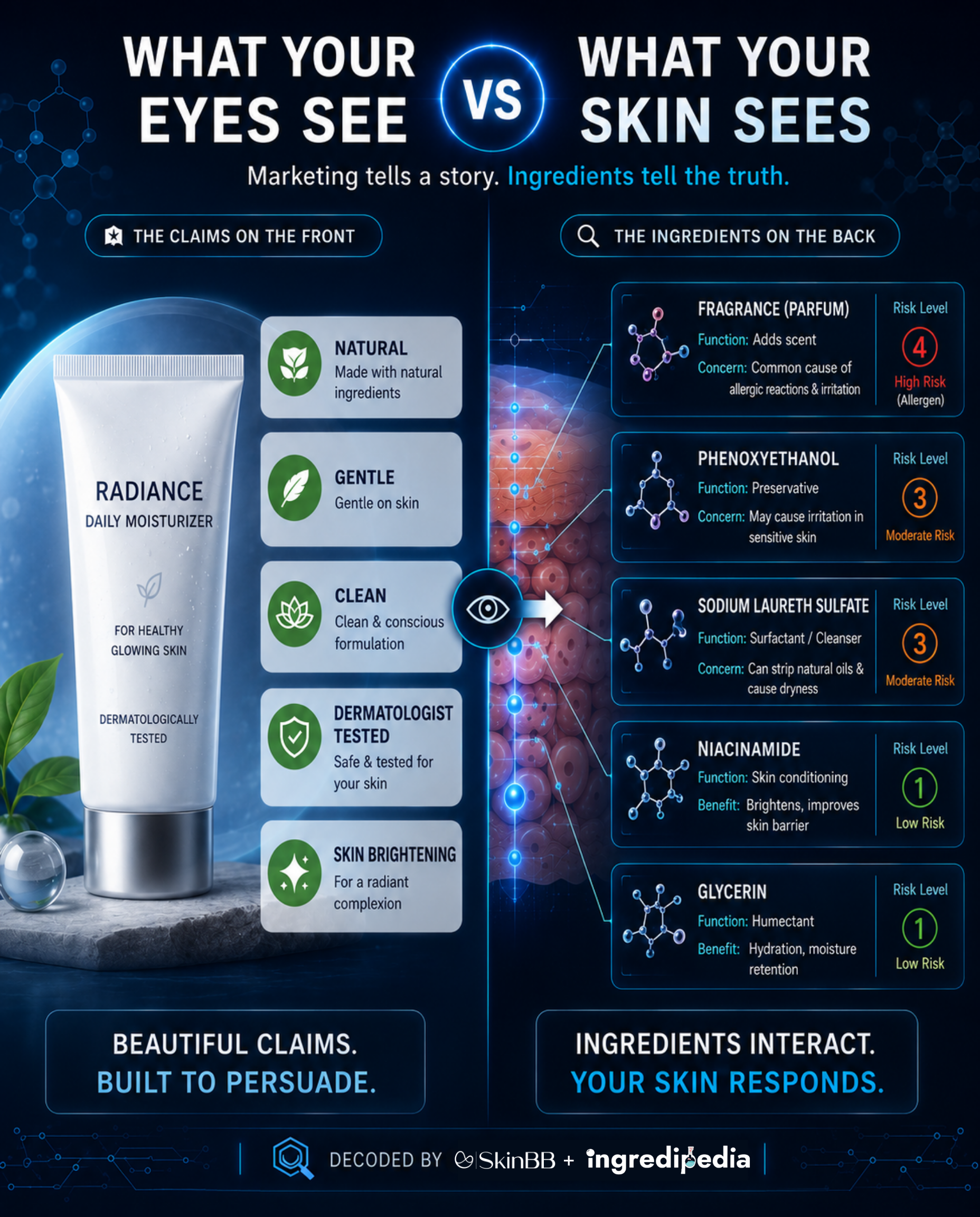
That last point is the real problem. Most consumers lack the scientific vocabulary to interpret an INCI list, and that is not a personal failing — it is a design choice of the industry, which has long benefited from labels that are technically honest and practically unreadable. Closing that gap is the single most useful thing a skincare platform can do. Label Looker, built on the depth of IngrediPedia, exists to do exactly that.
IngrediPedia is the science under the tool. Developed by SkinBB in collaboration with researchers at Swami Vivekanand College, Chembur, it is a curated repository of more than 1,000 ingredients — each documented for function, safety profile and likely impact across different skin types. It is the bridge between dermatological research and the person standing in the aisle.
Three things keep it trustworthy.
It is rigorous. Every entry draws on peer-reviewed literature, dermatological studies and recognised global safety guidance. The database is maintained against current research rather than frozen at the point of publication, so the reading you get reflects what is known now.
It is comprehensive. Ingredients are organised into functional groups — emollients, humectants, preservatives, surfactants, actives and more — and each entry records origin (natural or synthetic), primary role in a formulation, known allergen potential and skin compatibility. The structure makes the science legible without flattening it.
It is built for everyone. IngrediPedia is written to serve a curious consumer and a working formulator from the same source of truth. Translating expert science into plain insight is not a dilution of the knowledge; it is the point of it.
The process is deliberately simple, because the science behind it is not.
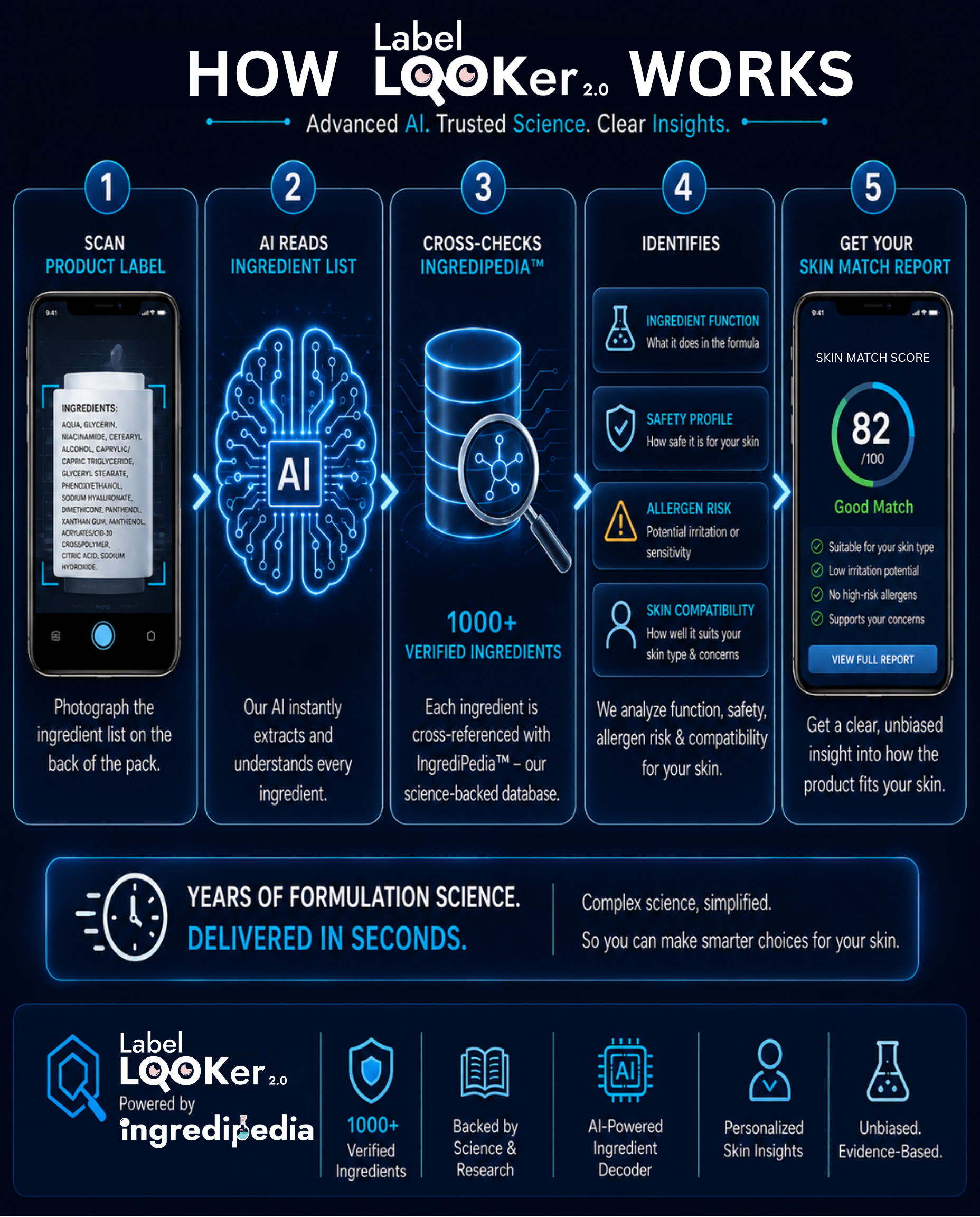
Open skinbb.com and select Label Looker. Photograph the ingredient list — only the ingredients, cropped to capture the full panel. Label Looker reads the list and cross-references every component against IngrediPedia. You receive a breakdown of each ingredient: what it does, where it comes from, how safe it is, and whether it carries allergen risk. Finally, you get a read on whether the product genuinely fits your skin type and concerns.
What takes a moment to do takes years of formulation knowledge to understand. That is the trade Label Looker makes on your behalf — surface in, substance out.
The case for this has grown sharper. Rising rates of eczema, contact dermatitis and acne have renewed attention on the irritants and allergens carried in everyday personal care products, and research into environmental and bioaccumulative compounds in cosmetics has widened the question from skin to health.
Consumers have responded. They are looking for products that are hypoallergenic, non-comedogenic and free of the ingredients they have learned to avoid. But intent runs ahead of information: inconsistent labelling and an industry vocabulary built on buzzwords leave even careful shoppers under-equipped. Label Looker meets that intent with evidence — clear, unbiased, and specific to the product in your hand.
This is where SkinBB draws its line. Label Looker is not built to push a verdict; it is built to surface the science and let you reach your own. Every scan returns research-backed information rather than a recommendation dressed as one. That commercial independence is the foundation of the trust the platform earns — and trust, once earned, is the only loyalty worth having.
It is also what the SkinBB philosophy has always meant in practice: apply knowledge to skin. Not faith. Not marketing. Knowledge.
The skincare industry has spent decades perfecting the front of the pack. Label Looker, powered by IngrediPedia, turns the pack over. It takes the part of the product designed to be skipped and makes it the part you understand best — confidently, accurately, and on your own terms.
The label was always there. Now you can see beyond it.
#SeeBeyond
1. What is Label Looker?
Label Looker is SkinBB's AI-powered ingredient decoder that helps you understand what's inside your skincare, haircare, and personal care products. Built on IngrediPedia, it analyzes ingredient lists and explains what each ingredient does, its safety profile, and its suitability for your skin.
2. What is IngrediPedia?
IngrediPedia is SkinBB's scientific ingredient database containing information on over 1,000 cosmetic ingredients. Developed in collaboration with researchers, it serves as the knowledge engine behind Label Looker, providing evidence-based ingredient insights.
3. How does Label Looker work?
Simply upload or scan a product's ingredient list. Label Looker uses AI to identify each ingredient, cross-references it against IngrediPedia, and generates an easy-to-understand report covering ingredient functions, safety considerations, allergen potential, and skin compatibility.
4. Do I need scientific knowledge to use Label Looker?
Not at all. Label Looker is designed to translate complex cosmetic chemistry into simple, understandable language so that anyone can make informed skincare decisions.
5. Can Label Looker tell me if a product is suitable for my skin?
Yes. Based on the ingredients present and the skin profile you provide, Label Looker helps identify whether a product may be suitable for your skin type and concerns.
6. Does Label Looker identify potential allergens and irritants?
Yes. The tool highlights ingredients that are commonly associated with irritation, sensitization, or allergic reactions, helping users make more informed choices.
7. Is Label Looker limited to skincare products?
No. Label Looker can analyze ingredient lists from skincare, haircare, body care, and other cosmetic and personal care products.
8. Does Label Looker recommend products?
No. Label Looker is designed to provide evidence-based ingredient information rather than promote specific products. It helps users understand formulations so they can make their own decisions.
9. How accurate is Label Looker?
Label Looker's insights are powered by IngrediPedia, a curated database built from peer-reviewed research, dermatological literature, and recognized safety references. However, it is intended as an educational tool and not a substitute for professional medical advice.
10. Can Label Looker identify harmful ingredients?
Label Looker does not label ingredients as simply "good" or "bad." Instead, it provides scientific context regarding ingredient function, safety considerations, usage levels, and known concerns so users can make informed choices.
11. Does Label Looker support ingredient transparency?
Absolutely. Label Looker was created to help consumers look beyond marketing claims and understand the science behind product formulations.
12. Is Label Looker free to use?
Availability of features may vary based on SkinBB's platform offerings. Users can visit SkinBB to learn about current access and feature availability.
13. Can Label Looker replace a dermatologist's advice?
No. Label Looker is an educational and informational tool. If you have a skin condition, allergy, or medical concern, you should consult a qualified dermatologist.
14. Why should I read ingredient labels?
Ingredient labels reveal what a product actually contains. Understanding them can help you avoid allergens, identify beneficial ingredients, compare products more effectively, and make choices that align with your skin's needs.
15. What makes Label Looker different from other ingredient checkers?
Label Looker combines AI-powered analysis with IngrediPedia's curated ingredient intelligence, offering not just ingredient definitions but context around function, safety, compatibility, and formulation science—all within a consumer-friendly experience.
