
Somewhere around the third month after delivery, a lot of new mothers notice more hair than usual on the pillow, in the brush, in the shower drain. By month four or five, handfuls. The internet, friends, in-laws, and doctors will offer between two and twenty explanations.
The actual answer is well-documented and largely reassuring: this is a recognised dermatological pattern called postpartum telogen effluvium, follows a predictable timeline, and in most women resolves on its own. The trick is distinguishing what's normal from what isn't, and which interventions move the needle versus which are folklore.
How common is postpartum hair fall? The plain answer: nobody quite knows. Older estimates put it at one-third to one-half of women. A 2016 review in Skin Appendage Disorders went further and questioned whether postpartum telogen effluvium even exists as a distinct entity, finding no statistically significant data showing different shedding amounts between pregnant and postpartum women.
This doesn't mean the experience isn't real — many women clearly do shed more after delivery. But the precise prevalence is less settled than confident articles suggest. Treat the timeline as well-established and the prevalence figures as approximate.
Three patterns warrant a doctor visit, not a wait-and-watch.
Patchy loss. Postpartum shedding is diffuse — affects the whole scalp evenly. Defined circular patches suggest alopecia areata, which is a different condition.
Persistent shedding past 12 months. Most cases resolve within 8–12 months. Beyond that, the cause is unlikely to still be the original postpartum trigger.
Loss with systemic symptoms — significant fatigue, weight changes, cold intolerance, mood changes. Postpartum thyroiditis affects roughly 5–10% of postpartum individuals and is treatable. Hair fall plus exhaustion plus weight changes is a thyroid screening conversation, not a shampoo conversation.
There's also an important pattern called unmasking: postpartum shedding can reveal an underlying hair-loss disorder that was already present but cosmetically hidden. Female pattern hair loss with a genetic basis, traction alopecia from years of tight hairstyles, or a thyroid condition can all become visible during the postpartum window because the natural shedding makes the underlying thinning impossible to ignore. If your "postpartum" shedding doesn't fully recover by month 12, the underlying condition — not the postpartum trigger — may be the real story.
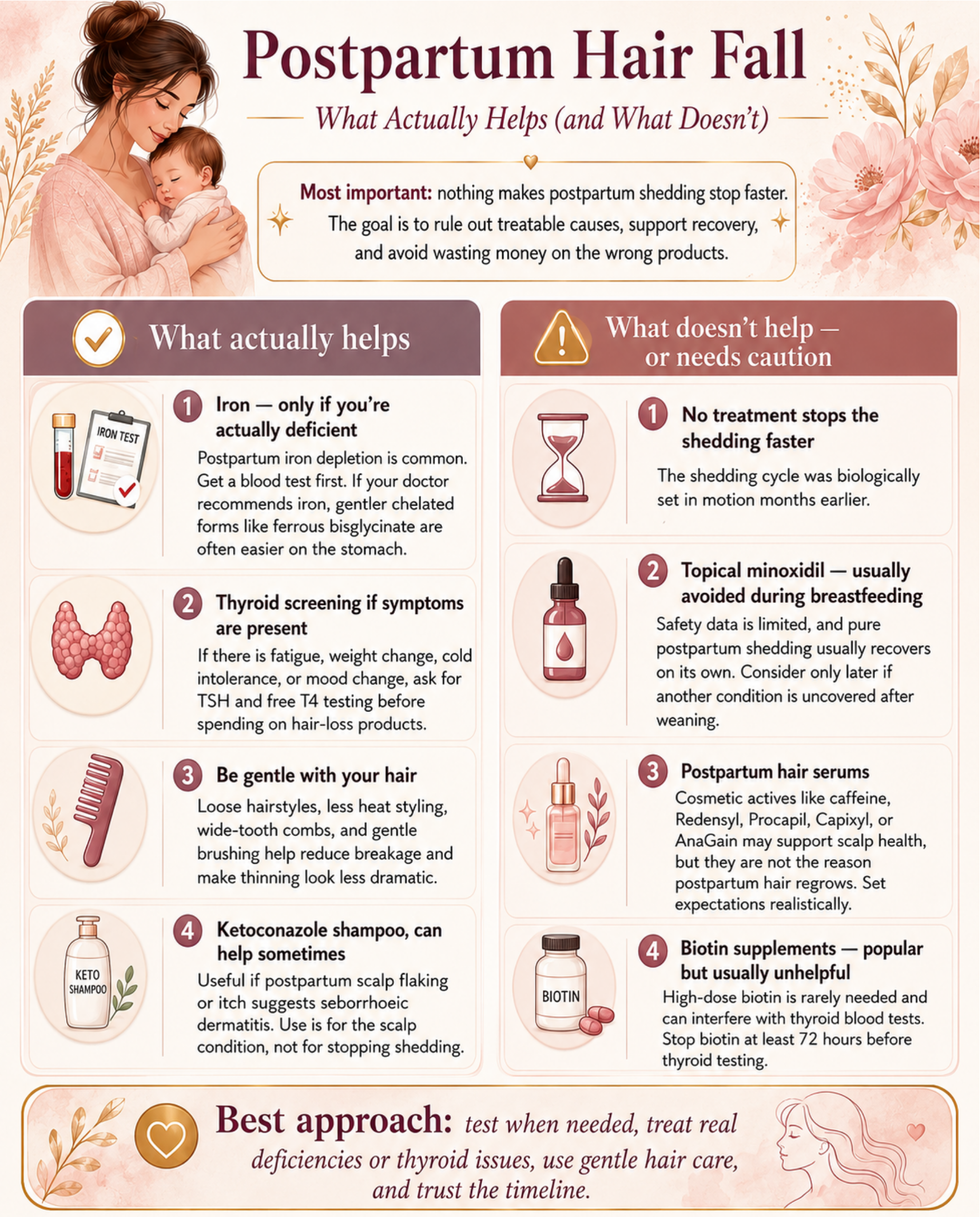
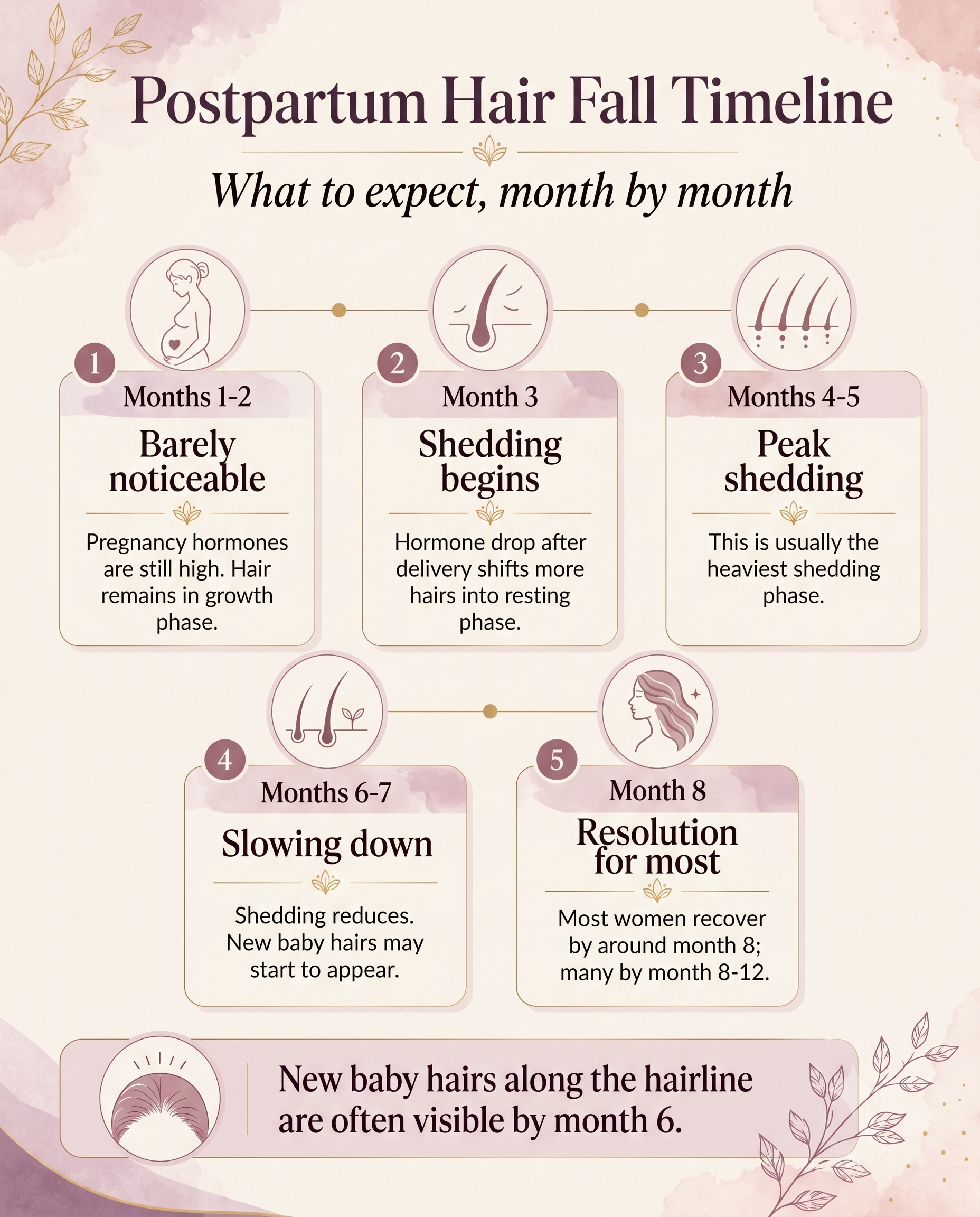
Postpartum hair fall is one of the most predictable patterns in dermatology. It begins around month 3, peaks at 5, and resolves by month 8 in most women. The job is not to stop the shedding — it's already happened biologically — but to rule out the few conditions that mimic or compound it (thyroid dysfunction, iron deficiency, alopecia areata, unmasked female pattern hair loss) and to support recovery with evidence-based interventions where appropriate. Skip the biotin unless deficient. Wait on minoxidil until weaning. Be honest with yourself about which products are doing real work and which are providing reassurance. The window of greatest worry — months 4 to 6 — is also the window where reassurance is most warranted.
Wondering if a postpartum hair product is worth its price? Tap LabelLooker on any postpartum-marketed shampoo or supplement on SkinBB. We surface the active ingredients and tell you whether the formula is built for the synchronisation pattern of postpartum shedding or for a different category of hair loss entirely — so you don't pay premium prices for a problem that's resolving on its own.
1. Skelton, J. B., et al. (2016). The Postpartum Telogen Effluvium Fallacy. Skin Appendage Disorders. https://pmc.ncbi.nlm.nih.gov/articles/PMC4908443/
2. Mirmirani, P., & Samrao, A. (2022). Postpartum Telogen Effluvium Unmasking Traction Alopecia. Skin Appendage Disorders. https://pmc.ncbi.nlm.nih.gov/articles/PMC9274946/
3. Skoner, J. A., et al. (2022). Postpartum Thyroiditis. StatPearls. https://www.ncbi.nlm.nih.gov/books/NBK557646/
4. Hughes, E. C., & Saleh, D. (2024). Telogen Effluvium. StatPearls. https://www.ncbi.nlm.nih.gov/books/NBK430848/
