
NAC is the OG glutathione supplement — decades of research, real clinical history, genuine effects. Glyteine® is the newer, smarter sibling that gets further down the pipeline. Here's the honest comparison.
If you've gone down the glutathione supplement research rabbit hole — and if you're reading this, you probably have — you've come across NAC. N-Acetylcysteine. It's been used in medicine for decades. It's the go-to emergency treatment for paracetamol overdoses. It's the reason hospital crash carts have it on the shelf. It genuinely raises cellular glutathione. So why is Glyteine® in Continual-G instead of NAC?
The answer is elegantly simple once you understand the two-step glutathione synthesis pathway.
Glutathione is made in two steps inside every cell. Step one: the GCL enzyme combines glutamate and cysteine to make γ-glutamylcysteine (the Glyteine® molecule). Step two: the glutathione synthetase enzyme adds glycine to make the finished glutathione tripeptide. That's it. Two steps, two enzymes, one goal.
NAC is a precursor to cysteine. When you swallow NAC, your body converts it to cysteine — one of the two raw materials needed for step one. So NAC's path to glutathione is: NAC → cysteine → (GCL step one) → γ-glutamylcysteine → (step two) → glutathione. Count the steps: three. NAC is three moves away from finished intracellular glutathione.
Glyteine® (γ-glutamylcysteine) is the product of step one. It enters the cell directly through its transporter and feeds straight into step two. Glyteine®'s path to glutathione: Glyteine® → (step two) → glutathione. One step. One move. Downstream of the bottleneck.
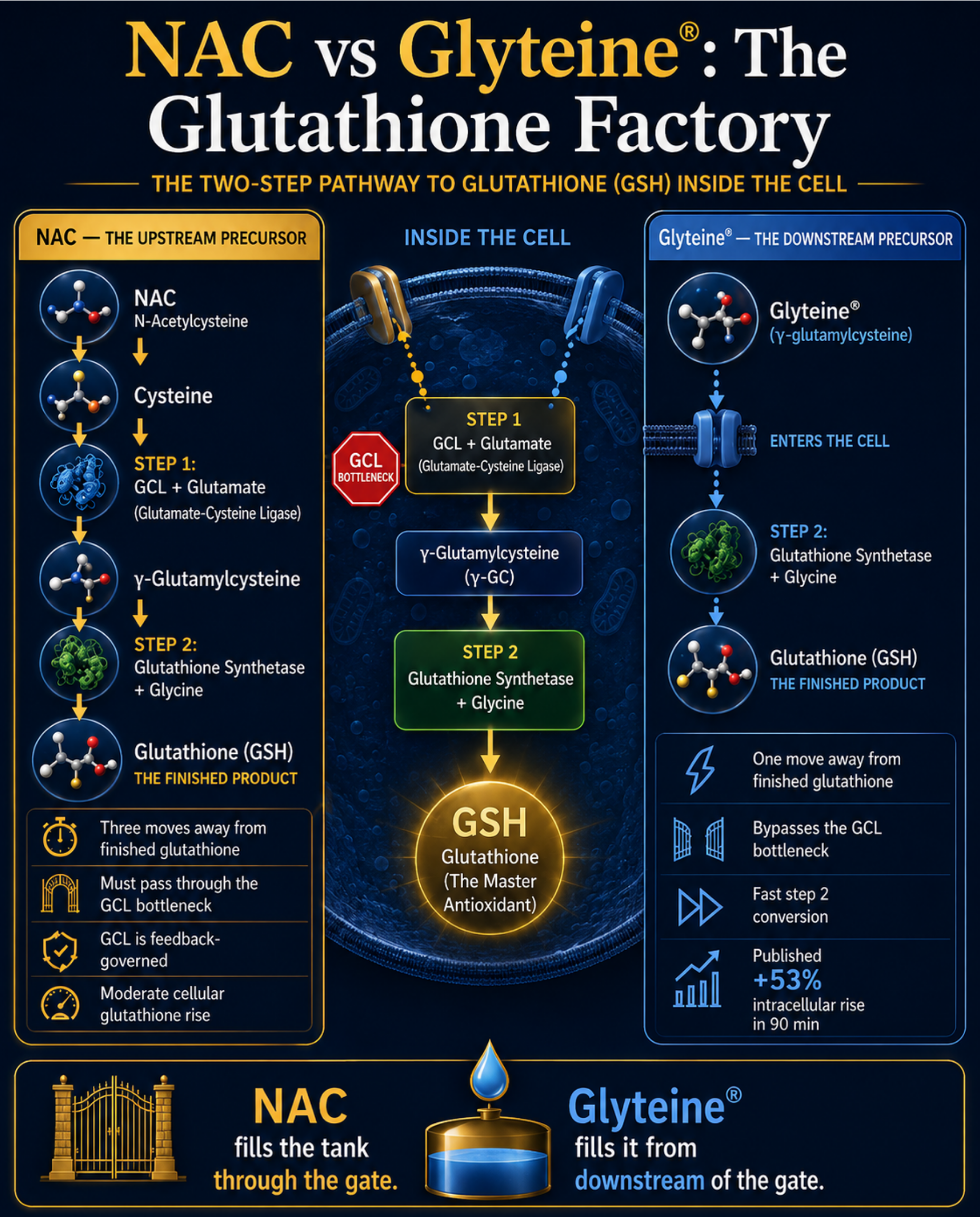
This is the critical practical difference. Because NAC feeds the GCL step — and GCL is feedback-inhibited by high glutathione — NAC's ability to raise cellular glutathione has a built-in ceiling. When glutathione rises due to NAC supplementation, the GCL enzyme slows down (it senses 'enough production, throttle back'). The rise from NAC is real and meaningful — but it's moderated by the cell's own governor.
Glyteine® bypasses GCL. The step-two enzyme (glutathione synthetase) runs with much less feedback regulation. It's faster, it's less throttled, and the cell can convert Glyteine® to glutathione more freely. This is why a single dose of Glyteine® produced a 53% intracellular rise in the Zarka & Bridge study — a magnitude that NAC at comparable oral doses has not achieved in published intracellular-measured trials.
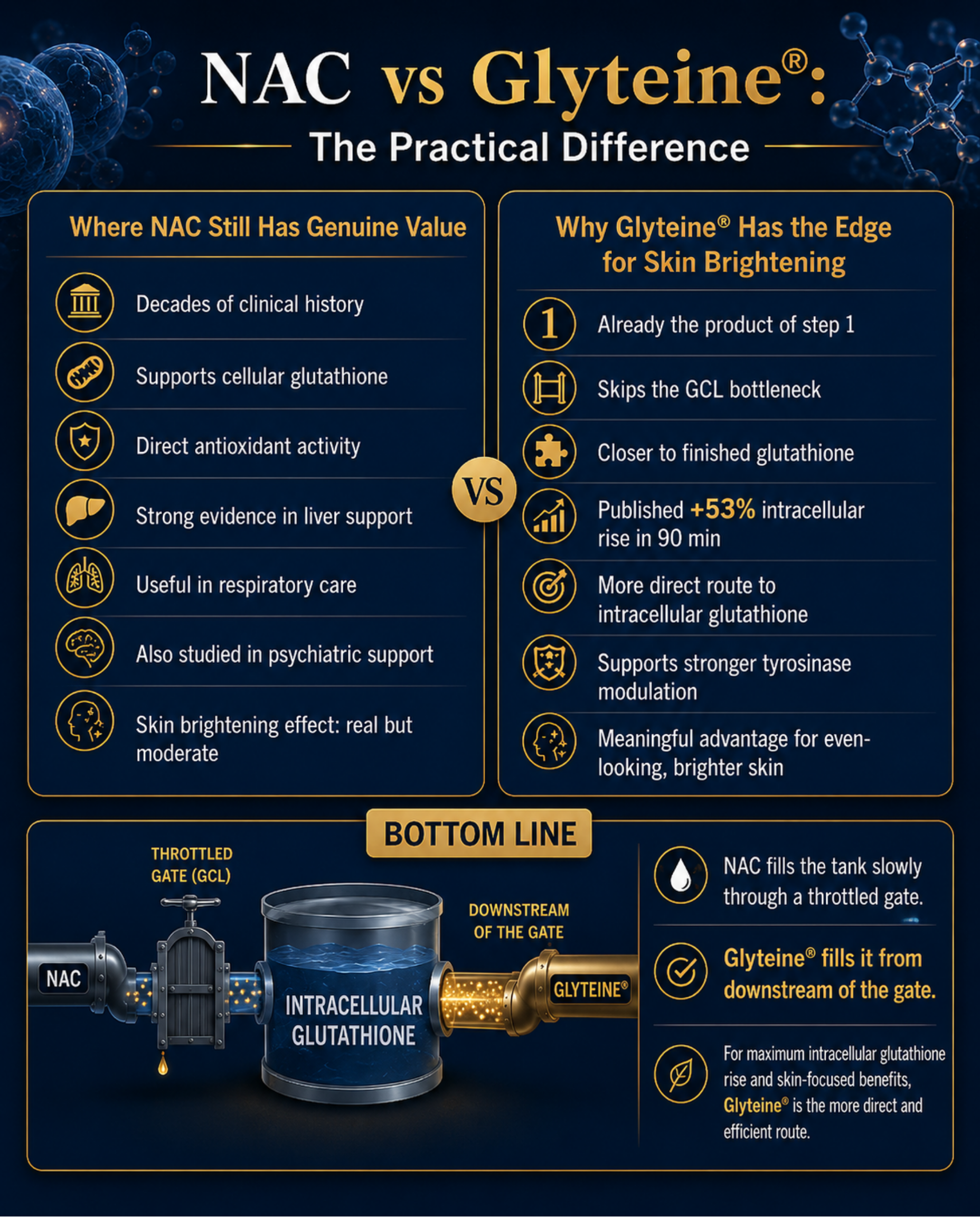
This comparison isn't a takedown of NAC. It is one of the most clinically validated supplements in human biochemistry. Its evidence for liver protection, respiratory conditions (it thins mucus), and even psychiatric applications (OCD, PTSD adjunct therapy) is substantial and stands completely independently of glutathione. NAC is also a direct antioxidant in its own right — donating electrons even before it becomes cysteine. If you have clinical reasons to use NAC, use it.
For the specific goal of maximising intracellular glutathione for skin brightness, liver support, and cellular antioxidant capacity — Glyteine® is the more efficient route. It's closer to the finish line by design.
For skin, the relevant mechanism is intracellular glutathione's effect on tyrosinase — the enzyme that drives melanin production. The higher intracellular glutathione rises above its natural setpoint, the more tyrosinase is modulated, and the more melanin production slows in a controlled, natural way. NAC produces a moderate rise through the GCL pathway. Glyteine® produces a 53% above-homeostasis rise by bypassing it. For skin tone evenness and brightening, the cellular depth of the Glyteine® effect gives it a meaningful advantage in the comparison.
NAC and Glyteine® are both glutathione precursors — but they operate at different points in the synthesis pathway. NAC is three steps from finished glutathione, passing through the GCL bottleneck. Glyteine® is one step from finished glutathione, bypassing the bottleneck entirely. For maximum intracellular glutathione rise — and the skin brightening, antioxidant, and cellular benefits that follow — Glyteine® in Continual-G is the more direct, more efficient, and better-evidenced choice. NAC fills the tank slowly through a throttled gate. Glyteine® fills it from downstream of the gate.
1. Can I take NAC and Continual-G together?
No documented safety concern with combining them. They operate at different points in the same pathway. NAC upstream + Glyteine® downstream could theoretically support both steps. Always consult a healthcare professional before stacking supplements.
2. Does NAC work for skin brightening?
NAC supports cellular glutathione, which includes some tyrosinase modulation. The skin effect is real but moderate — constrained by the GCL ceiling. For dedicated skin brightening, Glyteine®'s stronger intracellular rise gives it a meaningful advantage.
3. Is Glyteine® available as a standalone supplement in India?
Only through Continual-G on SkinBB — Skin Beyond Borders. It is the first and currently the only Glyteine®-powered supplement in India.
4. How does Glyteine® compare to cysteine supplements?
Same logic as NAC — cysteine must still pass through the GCL step (the bottleneck). Glyteine® skips that step. One move vs two or three moves to finished glutathione. Cysteine from food or supplements is useful but hit the same ceiling.
