
Your body does not absorb glutathione from food in any meaningful quantity. Instead, every cell manufactures its own glutathione through a precise two-step enzymatic process. Understanding this pathway is essential because every glutathione supplement strategy — whether it delivers glutathione directly, provides precursors like NAC, or uses a novel approach — must ultimately work within or around this cellular machinery.
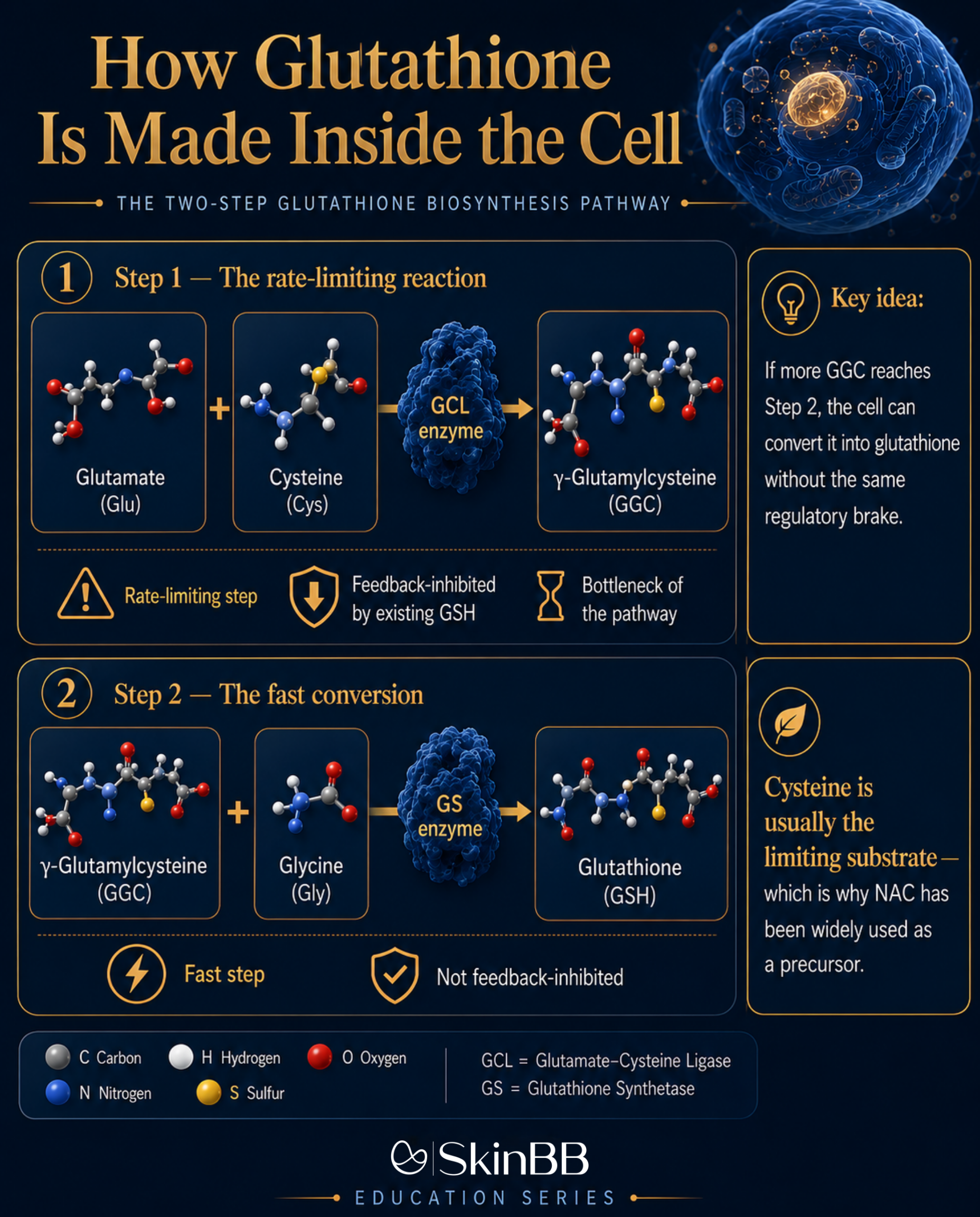
The first enzyme, glutamate-cysteine ligase (GCL), combines glutamate and cysteine to form a dipeptide called γ-glutamylcysteine (GGC). This is the slower, energy-consuming step that determines how fast glutathione can be produced. GCL is called the “rate-limiting enzyme” because it acts as a bottleneck: no matter how much raw material is available, production cannot exceed GCL’s processing capacity.
Crucially, GCL is subject to feedback inhibition by glutathione itself. When intracellular glutathione levels are sufficient, GSH binds to GCL and slows it down. This is an elegant self-regulatory mechanism — the cell prevents glutathione overproduction. But it also means that when you supply the cell with more raw materials (like cysteine from NAC), the cell may not increase production if it already senses adequate GSH levels.
The second enzyme, glutathione synthetase (GS), adds glycine to GGC to produce the finished glutathione molecule. GS is a simpler enzyme with higher catalytic activity than GCL. Importantly, GS is not subject to feedback inhibition by glutathione. This means that if you can get more GGC to GS, it will convert it to glutathione without any regulatory brake.
This asymmetry between the two enzymes has profound implications. The cell maintains extremely low levels of the intermediate GGC — approximately 7 micromolar, compared to millimolar concentrations of glutathione. The GGC that Step 1 produces is almost immediately consumed by Step 2. This creates a concentration gradient that becomes important when we discuss novel supplementation strategies later in this series.
Of the three amino acids required for glutathione synthesis, cysteine is typically the one in shortest supply. Glutamate and glycine are abundant in most diets. Cysteine, however, is less available and more easily oxidised. This is why N-acetylcysteine (NAC) has been the most popular glutathione precursor supplement for decades — it provides cysteine to the pathway.
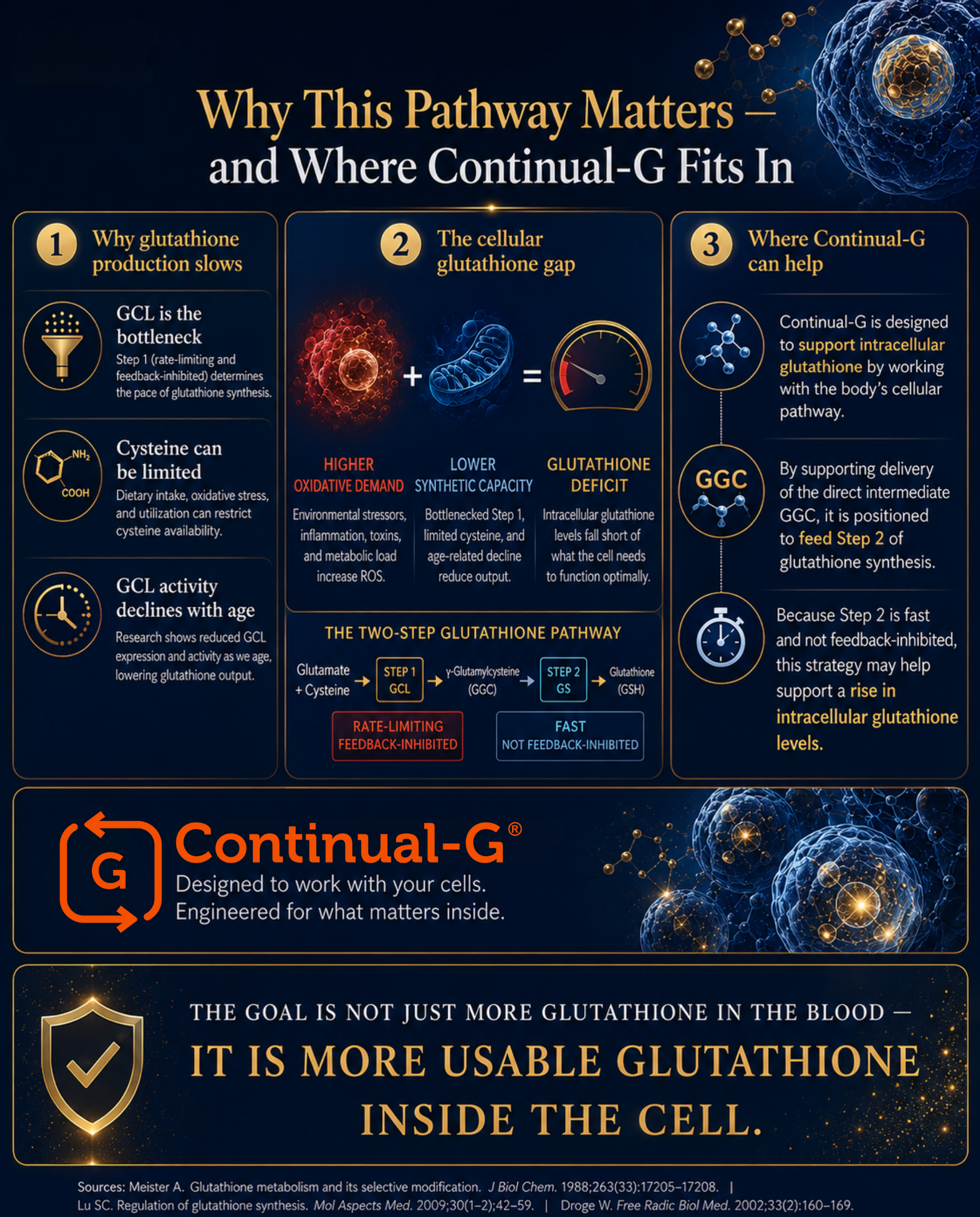
However, even with abundant cysteine, production is still gated by GCL activity. More raw material does not necessarily mean more glutathione if the bottleneck enzyme is already operating near capacity or is being inhibited by existing GSH levels.
Research has demonstrated that GCL activity declines with age. A study in the Archives of Biochemistry and Biophysics described how age-related reductions in GCL expression correspond to lower homeostatic glutathione levels across multiple tissues. This means older adults not only face greater oxidative challenges but have a reduced capacity to produce the very molecule that protects against them.
The combination of increased oxidative demand and decreased synthetic capacity creates a widening gap — what researchers call the cellular glutathione deficit. How to close this gap is the central question of glutathione supplementation science, and the answer depends entirely on understanding this two-step pathway.
References
1. Franklin CC, Backos DS, Mohar I, White CC, Forman HJ, Kavanagh TJ. Structure, function, and post-translational regulation of the catalytic and modifier subunits of glutamate-cysteine ligase. Mol Aspects Med. 2009;30(1–2):86–98. Available from: https://doi.org/10.1016/j.mam.2008.08.009
2. Ferguson G, Bridge W. Glutamate cysteine ligase and the age-related decline in cellular glutathione: the therapeutic potential of gamma-glutamylcysteine. Arch Biochem Biophys. 2016;593:12–23. Available from: https://doi.org/10.1016/j.abb.2016.01.017
3. Zarka MH, Bridge WJ. Oral administration of γ-glutamylcysteine increases intracellular glutathione levels above homeostasis in a randomised human trial. Redox Biol. 2017;11:631–636. Available from: https://doi.org/10.1016/j.redox.2017.01.014
4. Forman HJ, Zhang H, Rinna A. Glutathione: overview of its protective roles, measurement, and biosynthesis. Mol Aspects Med. 2009;30(1–2):1–12. Available from: https://doi.org/10.1016/j.mam.2008.08.006
