
You can choose a beautiful serum, layer it perfectly, and follow every rule online — and the single factor that decides how well it all performs is one most routines never think about. It isn't sitting on your bathroom shelf. It's flowing out of your tap. The wonderful news is that once you understand it, it becomes one of the easiest and most rewarding upgrades you can make.
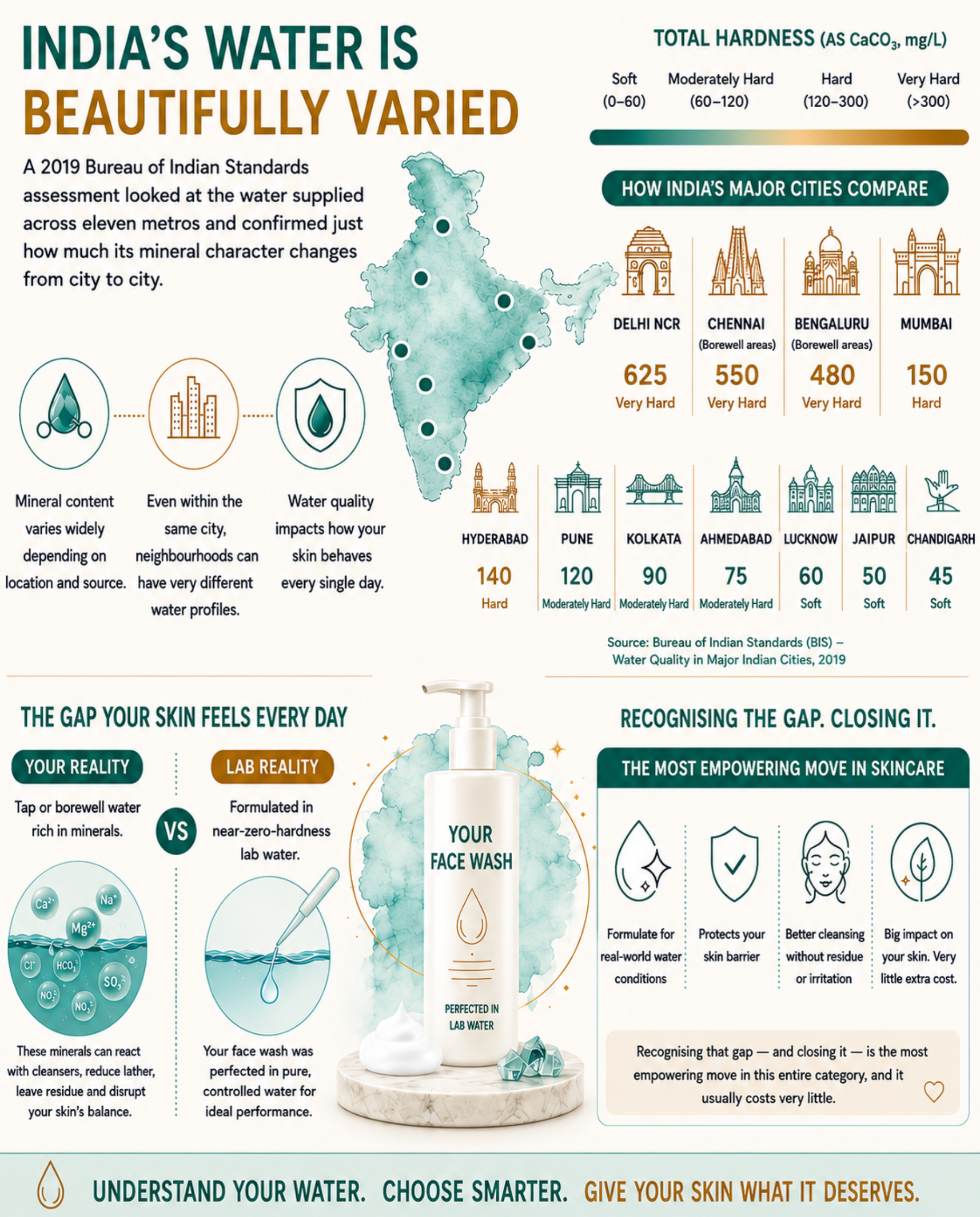
India's water is beautifully varied. A 2019 Bureau of Indian Standards assessment looked at the water supplied across eleven metros and confirmed just how much its mineral character changes from city to city. Parts of Bangalore on borewell supply run quite mineral-rich, Delhi NCR is among the hardest in the country, and several of Chennai's borewell-fed neighbourhoods sit close behind. Your face wash, meanwhile, was perfected by formulators in near-zero-hardness lab water. Recognising that gap — and closing it — is the most empowering move in this entire category, and it usually costs very little.
Every good cleanser does its job through surfactants — clever molecules that grip oil at one end and water at the other, gently lifting away the day so it rinses clean. The performance you feel — the lather, the slip, the squeaky-fresh-but-comfortable finish — comes down to which surfactants a formula is built around. And here is the key insight: surfactants differ in how they behave in mineral-rich water. Some are perfectly suited to it. Choosing one of those is the whole game.
If you've ever moved cities and noticed your favourite cleanser lathering differently, you weren't imagining it — the product stayed the same, the water changed. That observation is genuinely useful, because it points straight to the fix. It also explains why two friends in two different cities can rave about completely different cleansers and both be right: each has found the formula that suits her own water. Your goal is simply to find yours, and the path to it is short.
The lovely thing about surfactant chemistry is that it's predictable. Once a formula is built around the right molecules, it behaves consistently every single day — the same generous lather, the same clean, comfortable finish, wash after wash. That reliability is what makes a cleanser feel like a genuine favourite rather than a gamble, and it's entirely a function of which surfactants sit at the top of the list.
This is the heart of the matter, and it's good news from start to finish. A whole family of surfactants performs brilliantly in mineral-rich water, foaming and rinsing in your Mumbai or Delhi tap exactly as they did in the formulator's lab. Once you can spot them on a label, you hold all the power.
Sodium cocoyl isethionate — often shortened to SCI — is the star. It's the surfactant behind most premium syndet bars (the elegant bars that look like soap but are something cleverer), and its chemistry is wonderfully indifferent to calcium and magnesium. It lathers richly and consistently whatever your water is like, which is exactly why formulators love building gentle, luxurious cleansers around it.
Sodium cocoyl glutamate and sodium lauroyl methyl isethionate are its amino-acid-derived cousins, beloved in Korean and Japanese formulations for being supremely mild and equally unbothered by water hardness. If your skin enjoys a soft, low-key cleanse, these are a delight.
Decyl glucoside, coco glucoside and lauryl glucoside form a family called alkyl polyglucosides — made from coconut and sugar. They carry no electrical charge for minerals to interact with, so they stay completely steady in any water. You'll find them in baby cleansers and thoughtful sulphate-free formulas, and they tolerate absolutely everything.
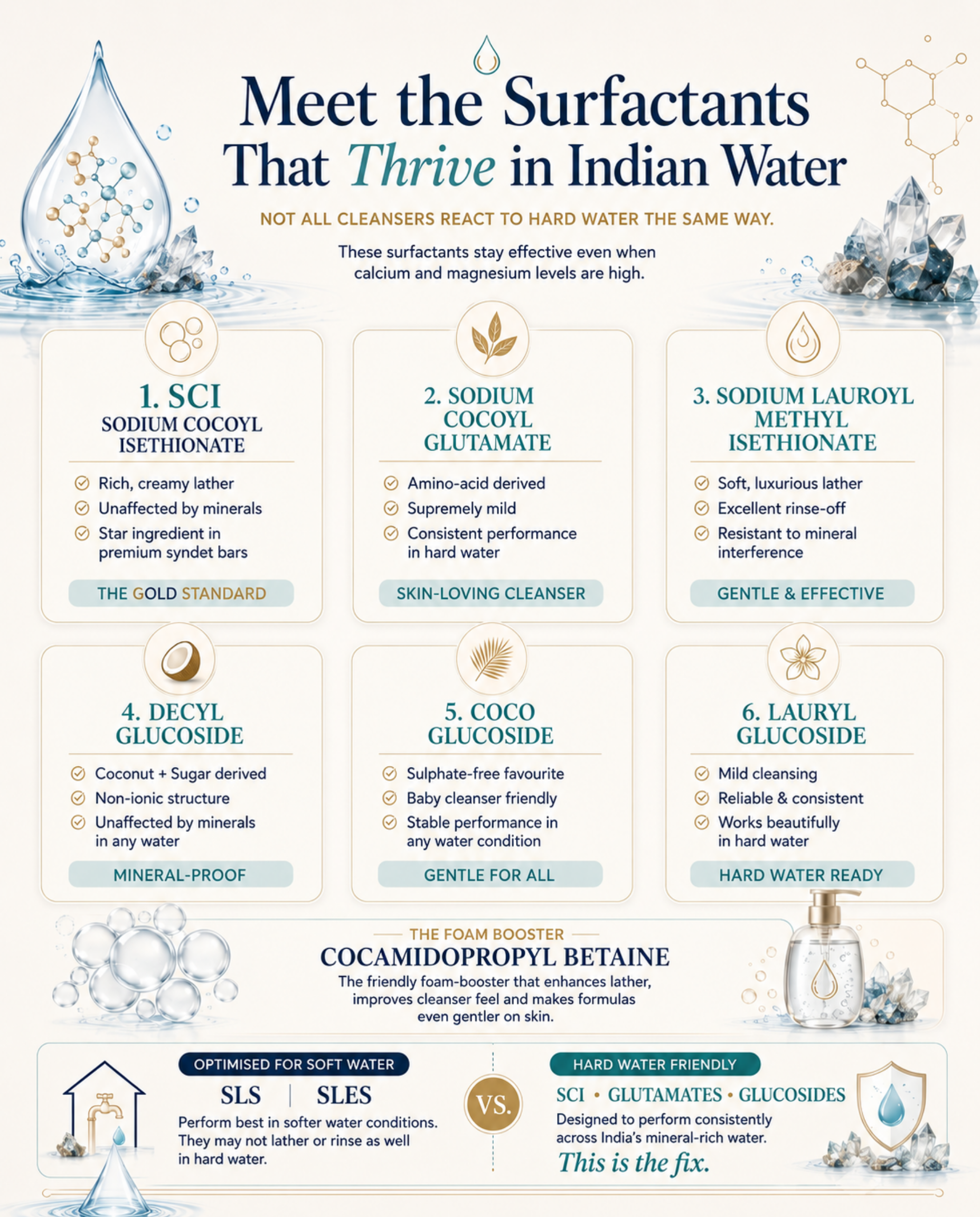
Cocamidopropyl betaine is the friendly foam-booster that rounds these formulas out, helping them lather generously and feel even softer on skin. When you see it paired with the names above, you're looking at a cleanser designed with care.
By contrast, surfactants such as sodium lauryl sulphate and sodium laureth sulphate are simply optimised for soft-water regions — they're a natural match where the water is gentle. So this isn't about good versus bad ingredients at all; it's about choosing the formula built for the water you actually have. That reframing is liberating: there's a perfect cleanser for every tap in India, and finding it is straightforward.
Here's the confident shortcut: the first half of an ingredient list tells you more about how a cleanser will perform on your skin than any claim on the front of the bottle. If sodium cocoyl isethionate, sodium cocoyl glutamate, decyl glucoside, coco glucoside or lauryl glucoside appear near the top, that cleanser was built to shine in mineral-rich water — which, for most Indian metros, means it was built for you. Reading those first few names takes half a minute and rewards you every single wash.
This is precisely where LabelLooker™ earns its keep. Tap it on any face wash on SkinBB and it instantly surfaces the surfactant type, so you can see at a glance whether a cleanser is matched to your water — no chemistry degree, no guesswork, just clarity in seconds.
Read enough labels and you'll spot ingredients like disodium EDTA, tetrasodium EDTA, sodium phytate or sodium gluconate near the bottom of the list. These are chelators, and understanding them correctly is genuinely empowering. Their job is to keep the formula itself beautifully stable — binding trace minerals that arrive with raw materials and manufacturing so the formula stays fresh and effective on the shelf. They're a lovely sign of a thoughtfully made product. The surfactant choice is what's matched to your tap water, and the chelator is what keeps the formula in peak condition until you use it. Knowing the difference means you read labels like an insider.
Here's a detail that makes the whole picture even more reassuring: not all minerals in water behave the same way, and magnesium is widely considered beneficial for skin. The balance between minerals matters as much as the total — which is exactly why water behaves so differently from one city to the next, and why a well-matched cleanser performs so dependably wherever you are. Your water has character, and the right formula works beautifully with it.
Putting it together is simple and satisfying, and you can be assertive about it because the wins are real. Start with a cleanser built around hard-water-friendly surfactants — that single choice does most of the work and is the upgrade I'd make first, every time. Finish with a finer rinse using filtered water for an extra-clean feel. And if you'd like to go further, a shower filter or a whole-house softener turns your entire home into soft-water territory, which your hair and body will love too. None of this is expensive, and all of it is squarely within your control. The very best part is that the fix lives upstream of your products, so it lifts the performance of every step that follows — your serums, your moisturiser, all of it work better on freshly, cleanly washed skin.
A few small habits make the upgrade even more rewarding. A short, lukewarm rinse is kinder and more comfortable than a hot one, and it leaves skin feeling soft straight away. Patting rather than rubbing dry keeps that just-cleansed comfort intact. And applying your serum or moisturiser while skin is still slightly damp helps everything absorb beautifully. None of this asks for extra time — it's simply doing what you already do, a little more intentionally, and noticing how much steadier your skin feels for it.
Two tools turn this knowledge into action. LabelLooker™ reads the surfactant story on any cleanser for you, instantly showing whether a formula is matched to mineral-rich water — so you choose with total confidence before you buy. And the SkinBB Community is where the human wisdom lives: women across different cities comparing which cleansers feel best in Bangalore borewell water versus Delhi supply, sharing favourites, and helping each other shortcut the trial and error. Between LabelLooker™ for the formulas and the Community for the lived experience, you're never guessing — you have the evidence in one hand and a supportive circle in the other.
Your water is the most rewarding variable to get right in Indian skincare, and the fix is refreshingly simple: choose a cleanser built around hard-water-friendly surfactants, finish with a filtered rinse, and add a shower filter or softener if you'd like the full upgrade. Match the formula to the water you actually have, and skin that once felt unpredictable becomes calm, comfortable and consistent. See beyond the bottle — the first three ingredients tell you more than the marketing ever could, and acting on them has never been easier.
1. How do I know if my cleanser is matched to my water?
Look at the first half of the ingredient list. Names like sodium cocoyl isethionate, sodium cocoyl glutamate, decyl glucoside, coco glucoside or lauryl glucoside mean the formula performs beautifully in mineral-rich water — ideal for most Indian metros.
2. Which cleanser surfactant is best for hard-water cities?
Sodium cocoyl isethionate (SCI) is the standout all-rounder — rich, consistent lather whatever your water is like. The amino-acid cousins and the glucoside family are wonderful gentle options too.
3. Do chelators like EDTA soften my tap water?
Chelators are there to keep the formula itself fresh and stable on the shelf — a lovely sign of a well-made product. The surfactant choice is what's matched to your water.
My skin feels different since I moved cities — where do I start? Your water character likely changed, which is great news because it's such an easy thing to optimise. Start with a hard-water-friendly cleanser and a filtered final rinse. Want city-specific recommendations?
4. Wondering if your cleanser is matched to your water?
Tap LabelLooker™ on any face wash on SkinBB to see the surfactant type at a glance. Want real-world tips for your city? Bring your question to the SkinBB Community.
Jabbar-Lopez, Z. K., et al. (2021). The effect of water hardness on atopic eczema and skin barrier function: a systematic review and meta-analysis. Clinical and Experimental Allergy, 51(3), 430–451.
Danby, S. G., et al. (2018). The Effect of Water Hardness on Surfactant Deposition after Washing and Subsequent Skin Irritation in Atopic Dermatitis Patients and Healthy Control Subjects. Journal of Investigative Dermatology.
ScienceDirect Topics. Isethionate surfactants — overview and water-hardness behaviour.
Bureau of Indian Standards. IS 10500:2012 — Drinking Water Specification (referenced via city water-quality assessments).
