
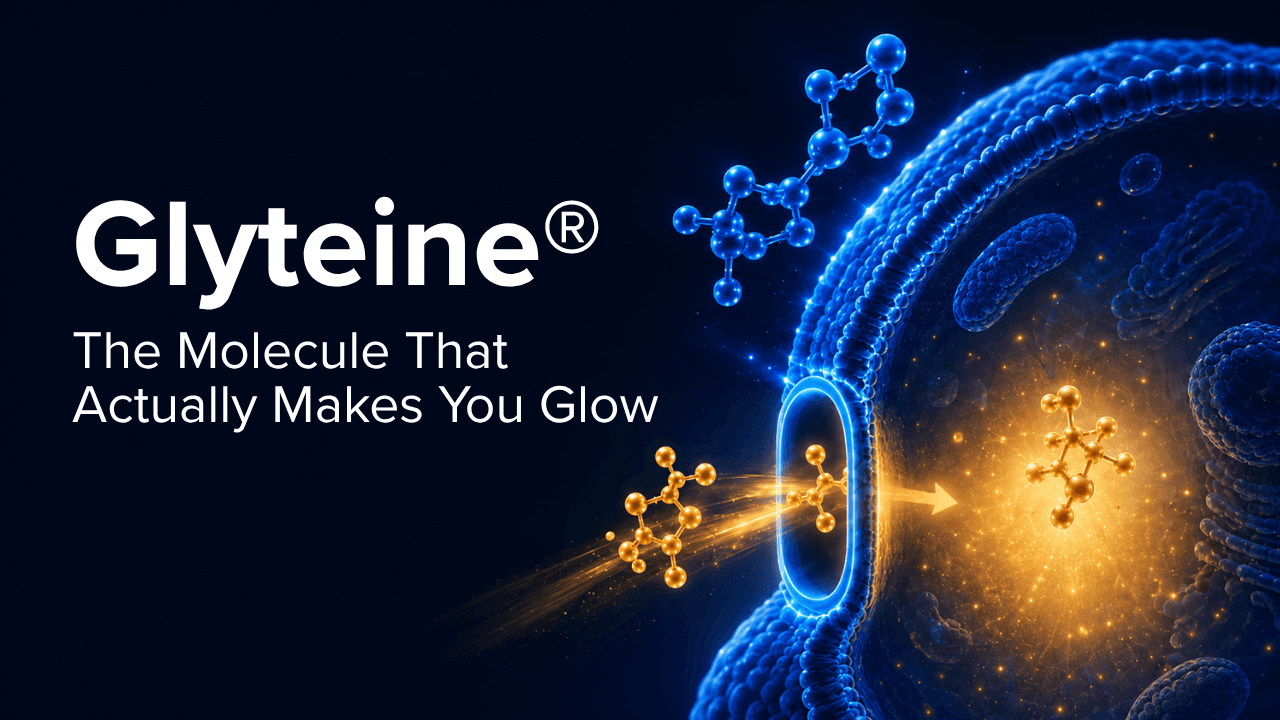
Everyone's talking about glutathione. But there's a molecule doing the real work inside your cells — and almost nobody is talking about it. Until now.
Let's start with something you've probably already heard: glutathione is the 'master antioxidant.' It's the molecule your body uses to fight free radicals, neutralise pollution damage, repair oxidative stress, and — this is the part that made the supplement industry billions — keep your skin looking bright, even, and genuinely glowing from within. The science on glutathione is real. It is not a wellness trend invented by someone on Instagram. It is foundational cellular biology.
But here is the part nobody mentions when they're selling you the supplement: the glutathione molecule itself is too big to enter your skin cells from the outside. And if it can't get inside the cell, it can't do the thing that makes your skin glow. It just... doesn't show up to work.
Here's the simplest way to understand this. Picture your skin cell as a tiny apartment. Glutathione needs to be inside that apartment to do its job — fighting free radicals, slowing down melanin production, keeping everything running clean and bright. Now imagine ordering a sofa for that apartment. The sofa is your glutathione tablet. The delivery arrives — but the sofa is too big to fit through the door. The delivery guy leaves it on the street. It does some good out there. But the apartment is still empty.
That's essentially what happens when you swallow a glutathione capsule or sit through an IV drip. Some glutathione enters your bloodstream. It does some things in the space outside your cells. But the inside of the cell — where the glow actually lives — stays unchanged.
Now imagine instead of ordering the finished sofa, you ordered flat-pack furniture. Smaller pieces. They fit through the door. Your cell assembles the sofa itself, from inside. That's Glyteine®.
So What Is Glyteine®, Exactly?
Glyteine® is the registered name for a molecule called γ-glutamylcysteine (gamma-glutamylcysteine). Don't let the name intimidate you — all you need to know is this: it's the intermediate step your cell naturally uses when building its own glutathione. Your cell makes glutathione in two steps. Step one produces γ-glutamylcysteine. Step two converts it into the finished glutathione. Glyteine® is the output of step one — given to you as a supplement, so your cell skips the hardest part and goes straight to step two.
The result? Your cell makes real, functional glutathione — inside itself — where it actually needs to be. Not in your blood. Not floating around in plasma. Inside the cell, where the magic happens.
Why Does Intracellular Glutathione Matter for Skin?
Your skin's brightness — that clear, even, lit-from-within glow — is largely determined by what's happening inside your skin cells. Three cellular processes are key. First, an enzyme called tyrosinase drives melanin production (more on this in Blog 09). Intracellular glutathione suppresses tyrosinase — meaning less melanin, more even tone. Second, free radicals from UV, pollution, and stress punch holes in your cell membranes and damage collagen. Intracellular glutathione is the first responder that neutralises them. Third, your body's other antioxidants — vitamin C, vitamin E — need glutathione to regenerate after they've done their job. Without it, your antioxidant defence network breaks down.
All three of these processes live inside the cell. Which is exactly why getting glutathione into the cell — not just into your blood — is the whole game.
In 2017, researchers Zarka and Bridge published a clinical study in Redox Biology, a peer-reviewed scientific journal. They gave healthy volunteers a single dose of Glyteine® and measured what happened to their intracellular glutathione — the glutathione inside the cells. At 90 minutes, intracellular glutathione had risen by 53% above each person's own baseline. Not plasma. Not blood. Inside. The. Cell. No equivalent published result exists for standard oral glutathione at typical doses.

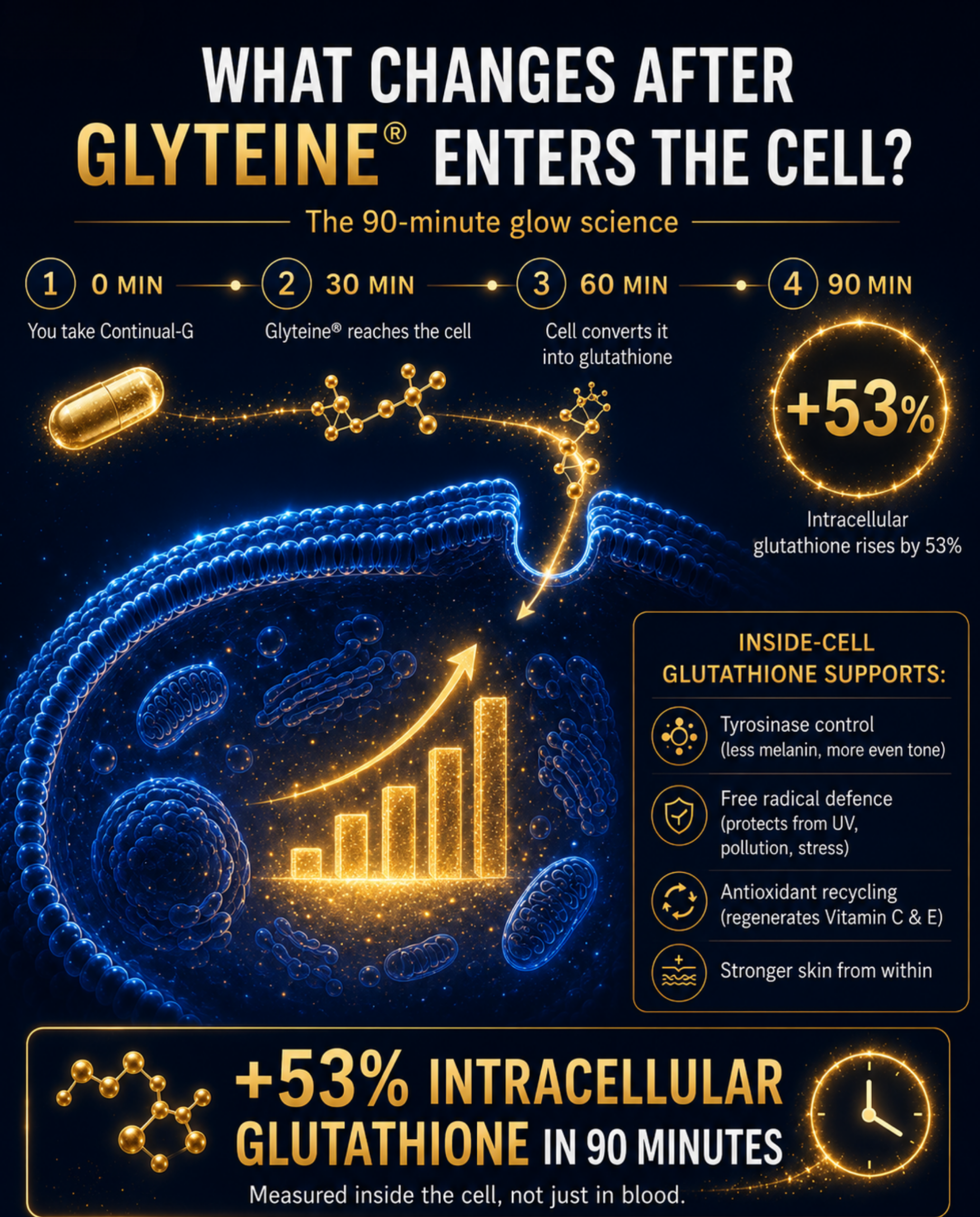

53% in 90 minutes from a single dose. This is not a marketing claim. It is a published biological measurement. And it is the scientific foundation that SkinBB — Skin Beyond Borders — built Continual-G on.
The molecule that actually makes you glow isn't glutathione the supplement — it's intracellular glutathione, the version inside your cells. Standard glutathione products can't reliably get it there. Glyteine® in Continual-G can — because instead of trying to deliver the finished molecule through a door it can't fit through, it delivers the building block your cell uses to make glutathione from the inside. The result is a 53% rise in intracellular glutathione in 90 minutes. That's the number. That's the glow. That's the whole story in one capsule.
1. What is Glyteine® in simple terms?
Glyteine® (γ-glutamylcysteine) is the building block your cell uses to make its own glutathione internally. Think of it as flat-pack furniture your cell assembles from inside — rather than a finished product too big to fit through the door.
2. Why can't I just take a glutathione capsule?
Glutathione is a large molecule that gets broken down in your gut (only 3–15% survives) and even the fraction that reaches your bloodstream can't efficiently enter cells. No cell membrane door exists for intact glutathione. Glyteine® has one — a specific cellular transporter that absorbs it directly.
3. Where can I buy Continual-G?
Exclusively on SkinBB — Skin Beyond Borders — India's dermatologist-directed wellness platform. It is the only product in India containing Glyteine® as its active ingredient.
4. How soon will I see results?
The intracellular effect starts within 90 minutes of your first dose. Visible skin changes — more even tone, less dullness, improved glow — typically appear over 8–12 weeks of daily use. The cell is working immediately; the skin surface takes time to catch up.
5. Is Continual-G safe?
Yes. Glyteine® has over 20 years of research behind it. Continual-G is FSSAI-approved as a non-specified food supplement. It contains no banned substances and is not a drug. Consult your doctor if you're pregnant, nursing, or on prescription medication.


