
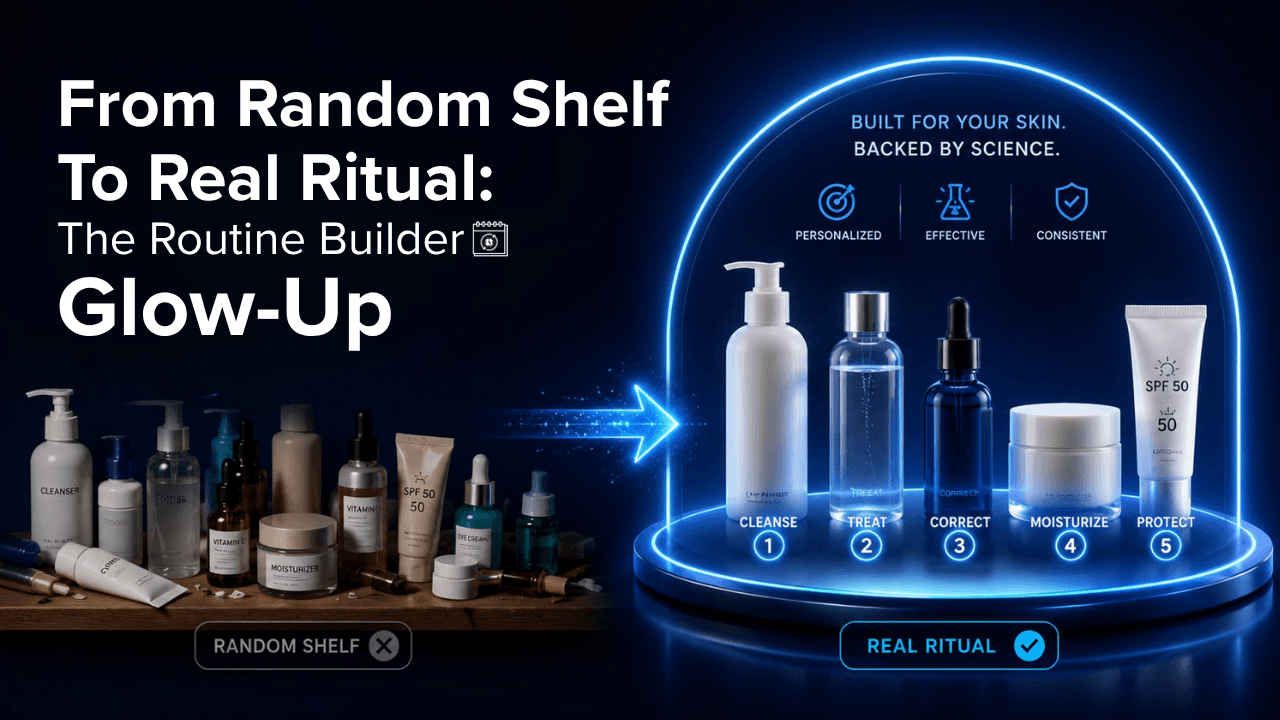
Most people's skincare routines don't start with intention. They accumulate. A product catches your eye at a pharmacy because of packaging. A friend raves about something, not because they understand the science, but because they had one good experience. An influencer mentions a serum in passing, and suddenly it's in your cart, joining a dozen other products in a chaotic bathroom ecosystem with no organizational logic, no strategic purpose, and no evidence that any of them work together.
This is the reality of skincare for most people. Walk into any bathroom and you'll see the evidence: half-empty bottles stacked haphazardly, products purchased months apart with conflicting mechanisms of action, an arsenal of ingredients that would be mutually antagonistic if anyone understood what they were doing. The expensive eye cream sits next to the acid exfoliant. The hydrating toner shares shelf space with an astringent toner. The retinoid rests beside vitamin C, despite the pH incompatibility that renders both less effective when layered carelessly.
The tragedy isn't that people don't care about their skin. It's that they've been given no framework for thinking about skincare systematically. The industry profits from chaos. Marketing thrives on impulse. But here's what dermatologists understand that most people don't: skincare isn't complicated. Your skin is a living, metabolically active organ with specific biological needs that follow predictable patterns. Those needs can be addressed with precision. The problem has never been the ingredients. It's the lack of ritual.
A skincare routine isn't a vanity project. It's a biological intervention designed around the actual cellular mechanics of your skin. Your epidermis operates on cycles. The stratum corneum turns over approximately every 14 days. Your basal cells take roughly 28 days to complete their journey to the surface before shedding. Your skin cells don't respond well to sporadic chemical assaults. They respond to consistent, predictable conditions.
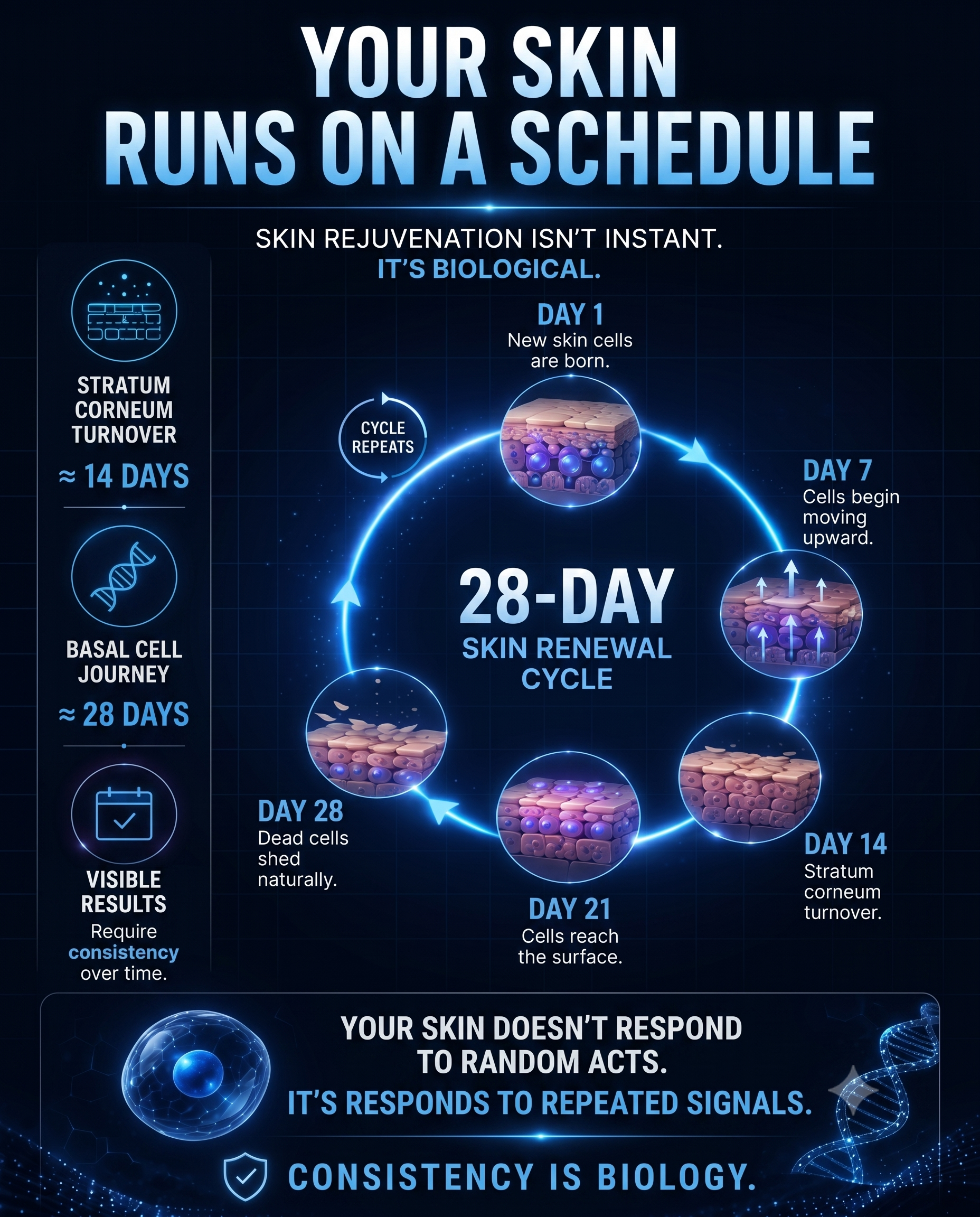
When you introduce a retinoid one night and abandon it for two weeks, your skin never adapts. Your cellular machinery never adjusts to work synergistically with the ingredient. Instead, your skin exists in a constant state of micro-inflammation and confusion. Contrast this with genuine consistency: within the first week of regular use, your skin barrier begins to anticipate what's coming. After four weeks, these adaptations compound. Your cells have optimized their response. Inflammation decreases. Results accelerate.
This is why one well-executed routine with three products used religiously outperforms a complicated routine with twelve products used sporadically. A structured routine also addresses layering and ingredient interaction. Hydrating toners create a slightly moist substrate that lets serums spread evenly. Lightweight serums penetrate better than heavy creams applied first. Moisturizers seal hydration in, preventing transepidermal water loss. This isn't arbitrary sequencing. It's pharmacokinetics applied to topical skincare.
Every effective routine rests on five foundational pillars, regardless of skin type. Step One is cleansing as barrier reset: removing the accumulated detritus of the day without compromising your barrier's structural integrity. A pH-balanced cleanser preserves your acid mantle while removing impurities. Step Two is treatment with targeted active ingredients reflecting your specific concerns, whether that's vitamin C for dullness, a retinoid for aging, or a soothing essence for sensitivity.
Step Three is hydration, the layer most people skip. Hydration means water content within skin; moisturization means sealing that water in. They're not the same. A hydrating toner or essence delivers humectants that bind water to your skin. Step Four, moisturization, seals that hydration in with emollients and occlusives, reducing water loss by up to 50% with good formulation. Step Five is protection in the morning (sunscreen, non-negotiable) or repair at night (a richer cream or treatment supporting your skin's natural overnight repair cycle).
Having a five-step framework is foundational, but skincare isn't one-size-fits-all. The Routine Builder functions as a personalization engine rather than a universal template. You input your skin type, primary concerns, secondary concerns, and sensitivities, and it maps your ideal sequence, prioritizing which concerns take precedence and showing you which existing products are helping, which are redundant, and which might be working against each other.
The transformation from a random bathroom shelf to a coherent routine is about shifting your entire relationship with skincare from passive consumption to active understanding. You stop buying things because they're trendy. You stop wondering whether you're doing it right because you understand the biological logic underpinning each step. Your skin becomes resilient instead of reactive, and the glow-up becomes the natural consequence of treating your skin systematically.
1. What's the difference between results I'd see in 2 weeks versus 6 weeks, and why does the timeline matter?
Your skin operates on biological cycles. The stratum corneum turns over every 14 days, but meaningful changes in skin quality take 28-42 days because they reflect deeper cellular adaptation and barrier remodeling. Within 2 weeks, you might see hydration improvements. After 6 weeks, you're seeing actual cellular-level change.
2. I have combination skin with oily T-zone and dry cheeks. Can I use the same routine everywhere?
Yes, with targeted adjustments. Use the same cleanser, hydrating layer, and SPF everywhere. For treatment, use a gentle exfoliating acid on your T-zone while using a nourishing serum on your cheeks, and a lightweight gel moisturizer on the T-zone with a richer cream on the cheeks. This respects different needs without requiring two complete routines.
3. How do I know if I'm experiencing irritation versus normal skin adjustment?
True irritation presents as persistent redness, burning, increasing breakouts, or visible rashes that worsen over days. Adjustment presents as mild dryness or slight temporary redness that resolves within 20-30 minutes and improves over 1-2 weeks. If you see worsening rather than improving symptoms, pause the product and focus on barrier repair.
4. Is it realistic to expect visible transformation, or is this aspirational marketing?
After 8-12 weeks of a well-structured routine, you should see measurable improvement in your specific concern, noticeable enough that people might comment. However, skincare has limits, it won't eliminate genetics or fully reverse severe conditions. It optimizes your skin within those constraints. That's realistic transformation: significant and measurable, not miraculous.
